Monday, April 30, 2007

Review: How Does Your Garden Grow

Today's book review is a bit different from usual. Normally I review books I have bought myself, or sometimes books I've had for years. But I was sent Chris Beardshaw's How Does Your Garden Grow by the publisher for review. I didn't promise to give it a favourable review though, so from that point of view you can trust what I say.

It's very different from any other gardening book I've seen, because it reads more like a science textbook than a typical gardening book. You'll become familiar with terms such as adventitious growth, auxins and meristems, you'll know your dicots from your monocots and be able to talk about phloem and xylem with authority. Beardshaw explains how plants work, so you'll understand how to help them grow better.

All this science gets translated into practical things you can do to improve your garden. For example, how best to take cuttings (that tip alone will save me a fortune in hormone rooting powder), how and what to feed plants, and how to prepare soil to give plants the best possible growing environment.

It won't be everybody's cup of tea. There's inevitably a trade-off between ease-of-reading and depth-of-information, and Beardshaw seems to think there are plenty of pretty coffee-table gardening books already, but a shortage of information-packed science-heavy gardening books. I agree. If you are the kind of person who wants to know why things work, if you are hungry to understand rather than just know, then I think you will find this book not only enjoyable but immensely useful. If science does your head in, maybe you should pass on this one, but you might still enjoy the online flash game that goes with the book.

Sunday, April 29, 2007

Hardening Off

When you raise plants from seeds or cuttings indoors they tend to grow rather soft and sappy. Standard gardening advice is that you should not plant such seedlings directly outside but should "harden them off" first. In theory, this involves setting the plants outside on a warm sunny day for around an hour, then bringing them back indoors. The next warm day you may set them out for a couple of hours, but be sure to bring them back in before night. In subsequent days, leave them out for longer and longer periods until they are toughened up enough to plant out.

In practice what invariably happens is this: on the first day you follow the instructions to the letter. On the second day you put them outside and forget about them. In the morning you think "Oh s**t, I wonder if my seedlings are all dead!", but find they seem to be fine (or possibly eaten by a cat) and then you plant them out whenever it's convenient.

Saturday, April 28, 2007

An Inconvenient Truth

I finally got round to watching An Inconvenient Truth last night. It's everything it's cracked up to be. If I say it's a 90-minute long lecture you won't want to watch it, but oh boy, I wish lectures were like this when I was at college, with shorts made by the Futurama team, jokes that are genuinely funny (unlike the jokes my lecturers made, and I'm afraid probably the jokes I make in my own lectures) and gripping movie clips.

I love the way Gore argues that acknowledging and acting on the reality of man-made climate change is not a political issue, it is a moral imperative. And I love the way his message is one of hope. At the end of the movie is a fabulous sequence - he has just convinced his audience (if they had any doubt before) of the reality and the seriousness of the problems we face. Then he lists all the amazing achievements of humanity - we fixed the hole in the ozone layer, we defeated fascism, we brought down communism, we ended the cold war, we put men on the moon, all by international co-operation. Illustrated with a montage of newsreel clips and probably accompanied by stirring music (I wasn't concentrating on the music), it makes you feel gosh darned proud to be human. Really. And then he mentions that we already have all the technology needed to solve climate change too. The only thing lacking is the political will to do so. The credits roll, listing a score of ways you can help - all simple like writing to your MP, changing your lightbulbs, or encouraging others to watch the movie.

I encourage you to watch the movie, especially if you still have any lingering doubt about whether man made climate change is real or not. It doesn't beat you around the head with stuff you've heard already. There was much in it that was new to me, and I consider myself fairly well-informed about this topic. It genuinely takes on the concerns of the sceptics and answers them. It's also entertaining. And it's on Sky Box Office (the pay-per-view section of Sky) at the moment, or you can search for cinemas showing it.

Friday, April 27, 2007

Thursday, April 26, 2007

Top Ten Reasons Why Everybody Should Grow Food

  1. It's good exercise - you may not feel happy at the idea of taking more exercise but research overwhelmingly shows that it boosts your mood and makes you happier.

  2. It gets you out in the sunshine - this also may make you happier if you are one of the approximately 1 in 10 who suffers from SAD.

  3. You get a sense of satisfaction from seeing a result of your effort.

  4. You will feel more motivated to eat fruit and vegetables when you have grown them yourself.

  5. Food will be fresher and taste better when you have grown it yourself.

  6. You will cut your food miles down to food yards, saving all the aviation fuel used to transport produce and reducing the damage to the planet.

  7. Many aspects of gardening seem miraculous when you are actually involved in them - you may know intellectually that seeds grow into plants, and waste decomposes into compost, but when you actually do it, it seems wondrous.

  8. It gives you something to look forward to. In the winter you look forward to spring when you can plant things. in spring you look forward to summer when they will grow. In summer you look forward to autumn and the harvest. In autumn you look forward to winter, a rest from your labours and a realistic prospect of getting the better of the damn weeds.

  9. You gain a much better understanding of what food is, where it comes from and what goes into it, and just how precious it is.

  10. You also gain insight into all the many people, past and present, whose lives have revolved around producing food. So many of the stories in the Bible, so many nursery rhymes and children's stories, as well as adult novels and poetry and many other cultural works, describe the process of farming and the consequences of failure. The news often carries stories of drought or floods or vanishing bees causing crop failures. We are cut off from understanding them fully by our modern way of life, but simply by growing a few vegetables we can understand rather better.

Wednesday, April 25, 2007

Downsize Your Fridge

There is no need to keep mustard, jam, marmalade, chutney, pickles in the fridge. These are all methods of preserving food from before fridges were invented. Unopened, they should keep almost indefinitely in a normal kitchen cupboard or other cool dark place. Once opened we all know they can eventually go mouldy, but it depends on how quickly you use them up. There's no point keeping a jar of jam in the fridge if you get through it in a couple of weeks. If you don't get through it in a couple of weeks, consider buying a smaller jar next time.

Eggs shouldn't be in the fridge, or most fruits and vegetables. Cheese and bacon are also "pre-preserved" foods, although before the invention of fridges they would have been stored in pantries or meat lockers built of stone or with thick walls, sometimes underground or at least on the shadiest side of the house and painstakingly protected from rodents and flies. I store my meat and cheese in the fridge, but whenever I put anything in there I always remove any bulky packaging first. There's no point spending money on electricity to keep loads of plastic and cardboard cool, and anyway it makes more space for food.

Experiment to find which produce really needs refrigerating, and what will keep just as well in a cupboard. Maybe you can downsize to a smaller, more energy efficient, fridge.

Tuesday, April 24, 2007

Cows With Guns

You know how I feel about anatomically-incorrect cartoon cows, but that aside, Cows With Guns is one of the funniest things I've ever watched on the internet.

If you're reading bean-sprouts at home, go and watch the song and video about, well, cows with guns. If you're at work just write the URL on a post-it note and take it home, because if the music doesn't draw your boss's attention, the sound of you laughing out loud certainly will.

Monday, April 23, 2007

Rhubarb and Custard

There's certainly a place for proper custard, or creme anglaise, made with fresh cream, eggs and vanilla pods. But for my money the best accompaniment to stewed rhubarb from the allotment is a dollop of Bird's Custard. It's not fine dining, it's unashamed comfort food.

Happy St George's Day, by the way.

Sunday, April 22, 2007

Happy Earth Day!

Apr 22 is International Earth Day. Did you know? I had never heard of Earth Day until last year, but it was created by the UN in 1970 and has happened every year since.

I wish it was more widely known. I wish Earth Day was a public celebration as important as Christmas or Valentine's Day. Something everyone knew the date of, and everyone made some effort to mark.

So I'm sending Earth Day e-cards from the Rustle the Leaf site to some of my friends. You can also send free Earth Day e-cards from Hallmark, Friends of the Earth and Greenpeace.

Earth Day happens every year on the same date, April 22. You can mark it by planting a tree, litter-picking at a beach, or installing a water butt in your garden next year. This year will you just help me to spread the word that Earth Day exists by sending a few free ecards to your family and friends?

Saturday, April 21, 2007

National Downshifting Week

Today is the start of National Downshifting Week. Don't worry - you don't have to give up your job, sell your house and become a craft potter in a Welsh commune (unless you really want to, in which case go for it). Why not try one of these tips to slow down and enjoy life more?
You've got a week, so no rush (well - that's the whole point, really). I'd love to hear what you do, and how it works out for you.

Friday, April 20, 2007

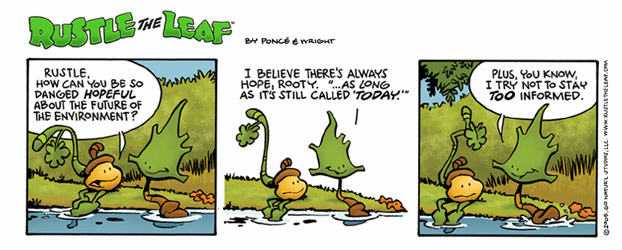
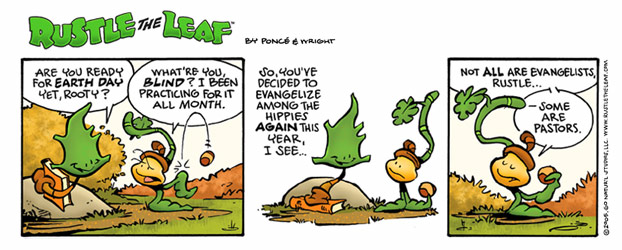
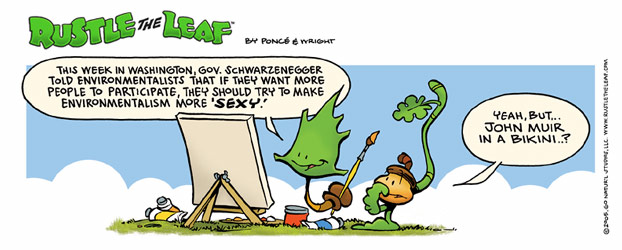
Rustle The Leaf

You've probably noticed that once a week there is a little comic strip at the bottom of each post. Maybe it's too small to read the words (sorry about that - I can't make it any bigger on the page) but if you click the panel you can view a larger version of the strip.

The strip is Rustle the Leaf, and Rustle has his own web site which is worth a visit. As well as an archive of all the Rustle strips since 2003, you can watch four animated Rustle movies, send e-cards, download colouring pages, e-books, wallpapers, lesson plans, and read the Rustle blog which gives more background to the issues raised in the comic strips. It's all free, and unlike too many other comic strips you are positively encouraged to include the strips on your own website.

It's not laugh-out-loud funny, but then again I don't think I ever laughed out loud at a "Peanuts" strip ("The Fabulous Furry Freak Brothers" were more my thing), but it's wry, beautifully drawn, and an antidote to the hand-wringing earnestness of too many green activists.

I hope you enjoy the weekly strips. I'll keep adding them as long as Ponce and Wright keep drawing them. I hope that's a long time to come.

Thursday, April 19, 2007

Edible Marshmallow Pillows

My dad sent us the Roald Dahl Book of Revolting Recipes, and we couldn't wait to try some of them. Of course the kids picked one of the most elaborate and daunting recipes in the book - edible marshmallow pillows (for when you wake up in the night feeling hungry).

I've never made marshmallow before, but it's easier than I thought. Basically you mix up a strong solution of gelatin, and boil some syrup to 240F. Then you combine them with an electric whisk until they go white and voluminous, like whipped cream or mayonnaise. Beat in an egg white and pour (quickly) into a container to set. (I'm deliberately not giving all the quantities and steps to make the recipe - if you want to make it, buy the book. The proceeds go to children's charities, but even if they didn't the author deserves to make a living)

We weren't quick enough with the first batch so it started to set and wouldn't pour nicely. We left that to set overnight and quickly whipped up another batch, which we poured into a lined Swiss roll tin in a smooth white layer.

The next day we did a few simple things that transformed our sheet of marshmallow into a realistic-looking pillow. The failed batch got cut into cubes and dusted with icing sugar, and were quickly devoured. I had mine in hot chocolate.

How did it taste? Well, exactly like marshmallow you buy so it's not really worth the effort of making your own, except to create the pillow I suppose. But the pillow did look spectacular. It would make an unusual birthday cake, or a themed dessert for a sleepover party. And it was fun to learn how something familiar is made - I always get a kick from that.

Wednesday, April 18, 2007

Interview with Andy and Dave from Selfsufficientish.com

One of my favourite websites is selfsufficientish.com, the fabulous online resource for urban self-sufficiency run by twin brothers Dave and Andy Hamilton. They both agreed to answer my questions about self sufficiency.

Bean-Sprouts: How did you first get interested in self-sufficiency?

Andy: As a child I remember making nettle soup and picking blackberries. We also had some apple trees in the back garden and a small veggie patch. As I have got older it has been more about asking myself "Can I do that instead of buying it?" When the answer is yes - whether it be growing my own veggies or making a fridge - then I will give it a go. For me it is about under-consumption, trying to live as gently on the planet as possible. Food miles make up for a lot of the carbon emissions and by growing my own and promoting growing your own I believe this can make a difference to the amount of fuel used.

Dave: My childhood experiences were of course very similar to Andy’s. Not long after living at home I moved to a house with rhubarb and nettles growing in abundance in the back yard. The garden was tiny but I was still amazed by the amount I got from these two crops without having to do very much (not even sowing the seed). Some years after that I experimented with growing some herbs then branched out to growing potatoes. The following year I was living in Oxford and had my first full size garden veggie patch. Despite the garden being over shadowed by trees on all sides I got a bumper crop of carrots, courgettes, parsnips, potatoes and in the following spring purple sprouting broccoli. This soon got me hooked and I launched into a two year experiment of growing the majority of my own food. This was a partial success as I managed to put something on the table every day for a year. Since then I have always grown something and am constantly improving my wild food knowledge.


Bean-Sprouts: What are you totally self-sufficient in?

Andy: I am totally self-sufficient in some herbs such as chives, rosemary, parsley and fennel. This year I am going to up the ante and introduce some more of the lesser grown herbs such as hyssop and chervil.
Last summer I was almost totally self sufficient in vegetables. My food bill for myself and my girlfriend was around £5 a week. It would have been well into the springtime this year if my freezer had not packed up, although I still have beetroot both stored and pickled and a load of jam. I am moving towards self-sufficiency in booze also, with a brew on the go almost all of the time and some stored up. I would say that every week of the year I have something that I have grown. I hope to store a lot more this year so that every meal I can have at least one thing on my plate that I have grown. I also tend to forage for mushrooms and other wild foods. If I find the time I dry my mushrooms, which keep for about a year.
It depends on what you call self sufficient for other areas in my life as I cook all my meals from scratch, own a bike not a car and mend clothes instead of buying new ones. I intend to make a solar hot water heater and solar ovens when the weather picks up. I hope to be self-sufficient in hot water for washing up and for some meals as a result.

Dave: It depends on the time of year for me. By the end of this month (March) I will be self-sufficient in salad greens and this year have planted enough fruit to be self-sufficient between at least June and October. This is my first year on my allotment in Bristol so all going well it will be from summer this year then ongoing that I will be self-sufficient in most of my food. I decided not to buy seed trays this year as I am recycling old yogurt pots, mushroom and drinks containers for my seedlings so I am also self-sufficient in those. Similarly I would have made enough compost to be self-sufficient in that soon. I intend to build a shed from scrap material at the allotment and will be harvesting rain water from the roof for my crops. I’m also reusing my bath water at home in my third floor flat for my seedlings.
A handful of other things myself and Andy do to be a little more self-sufficient (or self-sufficientish)
· A by-weekly forage in Bristol (sometimes more often in mushroom season)
· Both of us own a solar phone charger
· My desk top computer is made from salvaged parts.
· Andy makes bikes from salvaged parts
· Making own cleaning products
· Re-cycling and re-using everything possible!


Bean-Sprouts: What was your goal in setting up selfsufficientish.com?

Andy: No real goal as it were; we just wanted to share our experiences with others. I guess the closest to a goal would be the ideology of selfsufficientish, which is to reduce your impact on the planet by doing as much yourself as you can.

Dave: I very much saw the website as something that went hand in hand with what I wanted to do. My eventual goal has always been living in a self-sufficient environment and I saw the website as a way of sharing what could be done whilst living within the constraints of every day life. At the time I was a student living in a shared rented house and as most students are I was completely skint. Rather than let this limit me I decided it would be good to share the experiences I had in my chosen lifestyle. It was also a virtual way of sharing ideas.


Bean-Sprouts: What advice would you give someone just starting out in "greening" their lifestyle?

Dave: Don’t look at all the things you can’t do and let it put you off but see all the things you can no matter how small they might be. The first easy example that is always used is to change your light bulbs to energy savers as this is a sure fire way to cut down on carbon and reduce your electricity bill. Other tips are to put backs on your curtains to conserve heat, re-use your bath water in the garden or with houseplants, grow your own salad leaves or herbs on a windowsill. In short try and see what you do from day to day and see if there is a greener alternative – there usually is if you look for it.

Andy: I could not agree more with Dave on this question. Although I would add don’t fly to the list. I am off on holiday to Germany soon by train – my girlfriend is flying and I shall meet her there. I am not saying this makes me a better person, if I was some kind of eco-saint then I would not even use the train and instead cycle everywhere. I do think that we fly too much and even if you don’t think that man is changing the climate, flying still pollutes more than a train does.


Bean-Sprouts: What does the future hold for selfsufficientish.com?

Andy: We have just recently signed up with Hodder and Stoughton to write a book. It was not what we intended when we first started, but is very welcome. We hope that we can extend our message to much wider audience. We hope that it will be a book that you will be able to turn to whenever you want to do anything selfsufficientish. So it will cover topics from jam making, foraging and vegetable growing but also cover ethical shopping and how to make do and mend. We don’t want it to be another book that tells you that you are living your life un-environmentally, its not going to be written to give anyone a lecture. Instead we hope that people will be inspired to make small changes that make a real difference. We hope it to be the book that every selfsufficientisher, in fact everyone, will find invaluable. If you live on a small holding and have tons of spare time or in a bedsit and work all the hours God sends then you will find something you can do in this book. The book is called the selfsufficientish bible and is out in May 2008.


Thanks a lot, Dave and Andy. Good luck with the book, I'll look forward to that coming out.

Tuesday, April 17, 2007

Review: Scenes from a Smallholding

Scenes from a Smallholding by Chas Griffiths is without a doubt the funniest book about self-sufficiency ever written. Along with its sequel, More Scenes from a Smallholding, it made me laugh out loud every few pages. It also made me cry (at a beautifully-written scene when a baby calf is born, with some difficulty). And it taught me a lot I hadn't known before, about the relationship between farmers and supermarkets, about soil erosion, and about exactly what's involved in living off the land. I saw another review of the book which said "I was sorry when I finished it because I didn't want it to end". That's just how I felt.

Even if you're not interested in the subject matter (and you probably are because you're reading this blog) I reckon you'll enjoy this book. It's just so well written and so funny that you'll recommend it to everyone you meet.

Monday, April 16, 2007

Soap Nuts

I bought some soap nuts from Lakeland just to try them out. They're dried seed pods that make a soapy substance when they get wet. If you squish the wet pods in your fingers and bubbles come out. You put a few nuts in a little drawstring bag in with your laundry instead of using detergent, or you can put a few of them in the cutlery holder of your dishwasher. You can also reuse the same nuts a few times, and when they are exhausted you can put them on the compost heap.

In the washing machine they seem to get clothes clean, but then again I learned that clothes get clean even when you put nothing in the machine - no detergent, no "eco wash balls", nada. Still clean. So that's what we usually do nowadays.

I also tried them in my dishwasher. Now I know that stuff in the dishwasher doesn't get clean if you forget the dishwasher powder. I've tried it and the dishes come out rather manky. I've been looking for a more natural alternative to dishwasher tablets/powder for some time and these seem to fit the bill. The dishes came out clean, I was pleased with the result.

On the other hand the soap nuts come all the way from India. It seems a bit daft to be really fussy about eating only local food and then use nuts from India to wash the dishes afterwards. I also can't find any information about the condition these nuts are produced in. Are Indian farmers grubbing up the crops that feed their own families to plant soap nut trees as a cash crop? If so, are they being paid fair prices for the nuts? Or are people raiding natural forests to harvest these nuts now that westerners are suddenly buying them? Just what does commercial soap nut production involve?

When this packet runs out, I don't think I'll be buying any more. Although I'd be interested in them as an alternative to dishwasher tablets, there are just too many questions about their environmental impact for me to feel happy about using them.

Sunday, April 15, 2007

Lettuces

There's still a danger of frost in this area, but you can sow lettuces as long as they're protected. A cold frame is great, but if you plant small varieties like Little Gem you can use a two-litre drinks bottle with the bottom cut off as an individual cloche. Use a garden cane stuck well into the ground to prevent it from blowing over in the wind, and don't forget to water it because the rain can't get in.

Saturday, April 14, 2007

Recycling Crayons

I saw this great idea for recycling broken crayons on the blog An Irish Craftworker's Good Life. You put the small bits of wax crayon into patty tins in a warm oven (she recommends using the leftover heat when you've finished cooking the dinner, which is a nice energy-saving touch). They melt together into round multi-coloured crayons that give fun effects when you draw with them.

Friday, April 13, 2007

Spuds

We planted spuds on the allotment - Kestrel, Desiree, Red Duke of York, Pink Fir Apple, and some spuds that got forgotten in the bottom of the potato pile and started to sprout.

You can also plant spuds in a tub or barrel. Although I've never tried it this way myself I know some people who swear by it. Sam's class at school are doing it, and his teacher told me that Sam took over the class for a while to explain how compost is made and used, and how potatoes grow. Sam also corrected a pastor who was teaching the children the Easter story and the symbolism of Easter eggs - now the pastor knows that eggs only hatch into chicks when you have a cock as well as hens, otherwise the eggs are unfertilised.

Thursday, April 12, 2007

Mad About Herbs

I came across a great new blog called Mad About Herbs. It's by Madeleine Giddens and it has a free monthly newsletter with news, events and additions to the website together with inspiring and useful herb gardening, cooking and craft hints, tips and recipes. What's more, if you subscribe to the newsletter you get a free full-colour, high-quality herb calendar.

I've just planted a load of herbs in the allotment which were a birthday present from my dad, including some I've never used before so I'll be picking Madeline's brains about how best to grow and use them.

Wednesday, April 11, 2007

Easter Egg Recycling

Please remember to recycle the packaging from your Easter eggs:
  • The boxes can be recycled wherever you usually recycle cardboard. My council now collects card at the doorstep once a fortnight. Before that we used to take it to the local recycling centre. Or you might prefer to recycle it as heating fuel with a logmaker.
  • Foil can be recycled wherever you usually take cans and tins. Or you can smooth it out and use it to wrap sandwiches or other things you would use tinfoil for. If it is coloured (and clean) you might donate it to a school or nursery for crafts.
  • The plastic shapes that encase many eggs are more of a problem. If your council accepts plastic for recycling - lucky you. Mine doesn't. See if you can think of a creative way of reusing them, such as plant propagators. Or donate them to a school or nursery for junk-modelling projects.