Sunday, July 08, 2007

Bloggers for Positive Global Change

Anne at downshifting-path to simplicity nominated me for the Bloggers for Positive Global Change Award. Thanks so much for thinking of Bean Sprouts, Anne.

The award is the brain child of Climate Of Our Future to commemorate blogger's efforts around the world to share their knowledge, thoughts and inspirations in making this a better, healthier, more sustainable world.

I nominate the following five blogs for the award in turn:
  1. Ducking For Apples. I'm collecting two beehives from Ally today so I want to keep on her good side. But even if that wasn't so, it would still be an entertaining and inspiring read
  2. The Worsted Witch. Proof that you don't have to be nice all the time to save the planet
  3. Fluffius Muppetus. Saving the world, one carrot at a time
  4. A Satisfying Journey Towards Simplicity. A family living by the maxim "Be the change you want to see in the world"
  5. EcoStreet. An interesting read and a useful resource
Fellow Positive Global Change Award recipients, it’s easy to participate in this meme. At minimum, you can proudly display the BPGC badge( Click here for the image url )on your blog and bask in the glow of our collective good will. If you are sharing the kudos, however, please make sure you pass this list of rules to the blogs you are tagging. The participation rules are simple:

1. When you get tagged, write a post with links to up to 5 blogs that you think are trying to change the world in a positive way
2. In your post, make sure you link back to this post to so that people can easily find the exact origin of the meme.
3. Leave a comment or message for the bloggers you’re tagging, so they know they’re now part of the meme.
4. Optional: Proudly display the “Bloggers For Positive Global Change” award badge with a link to the post that you write up.

Comic strip from Throbgoblins.

Saturday, July 07, 2007

Savage Chickens

Feeling bored? I love Savage Chickens, one-panel cartoons drawn on yellow sticky notes and featuring chickens. Go and waste half an hour looking at chicken cartoons.

Alternatively, you could solve a logic puzzle and win a package of Skooperboxes.

Friday, July 06, 2007

Recipe: Lemon Meringue Pie

Here it is, as promised - a recipe for the best ever lemon meringue pie. I know it looks long but trust me, it's really easy.

Step 1: The pastry shell. You can use your own shortcrust pastry recipe, or ready-made pastry or a ready-made pie shell. Here is my favourite shortcrust pastry recipe for when I'm really pushing the boat out. It makes the best ever mince pies, for example. Sift 7oz plain flour into a bowl with ½ teaspoon of salt. Make a well in the centre. Add 4oz diced softened (really soft) unsalted butter, 2oz caster sugar, 4 egg yolks and ½ teaspoon vanilla essence into the well and then rub in. In fact I usually heave it all into my food processor with a dough hook attachment and let it run until it looks like pastry. Bring it together into a ball and knead it lightly, then wrap it in clingfilm and chill it for at least half an hour before using.

Roll it out, but it's a b****r to handle, so if it falls apart when you try to line your greased 9-10” pie tin with it, don't panic. Just smoosh it back together with your knuckles, and feel free to cover any holes with leftover bits of pastry and work them in until you can't hardly see the join no more. Stab the bottom with a fork a few times, put a sheet of tin foil inside and fill with blind baking beans, dried chickpeas, or whatever you can find to weigh it down evenly. Then bake at 200°C, 400°F, gas 6 until golden brown and set aside to cool. Turn the oven down to 150°C, 300°F, gas mark 2 whilst you sort out the filling.

Step 2: The lemon filling. You can use a jar of Hedgewizard's lemon curd, but if you're making the lemon filling just for the pie it's more economical to use a slight variation: separate 3 eggs. The whites will become the meringue, the yolks become the lemon curd. Put the yolks in a pan with the juice of 2 lemons, 3oz sugar, 2oz butter and a tablespoon of cornflour. Heat over a moderate heat whilst beating all the time until the mixture thickens. Then quickly pour it into the prepared pie shell.

Step 3: The meringue. Whisk 3 egg whites until they form stiff peaks. Gradually beat in 6 oz of caster sugar, then spread the mixture all over the lemon pie filling. It's important to spread it right to the edges and seal in the filling. Don't be too neat smoothing down the top - I like quite a spiky meringue topping. Bake at 150°C, 300°F, gas mark 2 (you did remember to turn the oven down, didn't you?) until the outside of the meringue has turned sort of beige in places. It takes quite a while - meringues dry out slowly in the oven rather than bake. We're talking at least half an hour, perhaps more.

The meringue will be squidgy in the middle. It's supposed to be. Those meringues you get at the shop that are crispy all through like styrofoam, they're made differently with boiling sugar syrup and all kinds of messing about. Don't pay them no mind.

Eat your pie hot or cold. I prefer it cold. It doesn't need cream or ice cream or anything else. It is perfection; complete just the way it is. My sister, Steph, used to make individual mini lemon meringue tarts and they were really nice. The recipe is exactly the same but you'd cut small circles from the pastry and bake them for a shorter time in a jam tart pan (don't worry about the blind baking beans, but do prick the bottoms or they might puff up), then fill with little dollops of lemon curd and meringue mix, and bake them for a shorter time, until they turn beige.

Thursday, July 05, 2007

Win A Skooperbox

I've been given three packets of Skooperboxes, a recycled biodegradable dog-poop scooper. Most people I know re-use supermarket plastic bags to scoop poop, but more and more places are phasing out plastic carrier bags or banning them altogether. Other people don't like the hand-to-poop contact, even with an intervening layer of plastic, and would welcome an effective way of scooping poop without getting their hands warm.

You can win a package of Skooperboxes by solving the following logic puzzle:

Walking my dog in the park, I passed four other dogs and made the following observations. Shep had lovely golden fur. The black dog had a green collar. Patch was not white, and Bobby was not brown. Lucky had a blue collar, and the white dog did not have a red collar. Bobby's collar wasn't green, and one of the dogs had a yellow collar but I don't recall which one.
Can you match the dogs' names with their colour and the collars? Email your answers and your postal address to Bean Sprouts. Correct answers will be entered into a draw and the winners will be announced next Thursday. Good luck!

Edited at 10:06
Thanks to Steph for pointing out that I already know my own dog's name, colour etc. The puzzle is about the four other dogs I passed. There are only four dogs in the puzzle: four colours, four collars, four names.

Wednesday, July 04, 2007

Saving Tomato Seeds

I have been saving tomato seeds to plant next year by scooping them out onto pieces of kitchen paper (or toilet paper or blotting paper) and letting the jelly dry out. Then I put them into unlabelled envelopes so that next spring I have great fun planting seeds without any idea what's going to come up. For even more fun, put the unlabelled envelopes in the shed and forget about them until 2012, so that you also have the fun of wondering whether 5-year-old tomato (probably) seeds will even germinate at all.

Tuesday, July 03, 2007

What is a Carbon Footprint?

A few days ago I explained why us greenies keep banging on about carbon. I know many Bean-Sprouts readers are red-hot on the science and politics of environmentalism, but please bear with me whilst I explain for the rest of the class. If you pay attention, you might even learn something you didn't already know.

Carbon Whatprint?

Digging up fossil fuels and burning them releases more carbon dioxide into the atmosphere which causes climate change. So we want to stop doing that. But how can you tell what sort of things you should be doing? Do low energy lightbulbs really make that much difference? How about cycling instead of driving? What about air travel? Because I really like going on foreign holidays and I don't want to give it up if it doesn't actually make all that much difference.

You can find out by calculating your carbon footprint. That's a measure of how much carbon dioxide you are personally responsible for. For example, if you gave up your car and cycled instead, you'd burn less petrol and release less carbon dioxide. That ought to be fairly easy to calculate if you know how many miles per gallon your car does.

But what about the carbon dioxide produced to make the bike? You've just gone out and bought a new bike, so that needs to be taken into account. How on earth can I find out how much carbon dioxide is produced in making a bike? And what about my new lycra shorts, wrap around sunglasses and Camelbak hydration system? How much carbon are they responsible for?

Footprint Challenge

Fortunately there are any number of websites to help you calculate your carbon footprint painlessly. So that's July's challenge - go and calculate your carbon footprint. That's it. I don't care if it's sky-high or close to zero. Just take a few minutes and find out what it is. Don't forget to vote in the poll in the right-hand sidebar when you've done it. Once you've calculated your carbon footprint, maybe you'll want to think of ways to reduce it. Perhaps you could carry out a carbon audit every year and see how low you can go. But that's not the challenge - the challenge is simply to calculate it. What you do after that is up to you.

Some Carbon Calculators

Carbon Calculator.co.uk
Inconvenient Truth Carbon Calculator
My Carbon Footprint.eu

Monday, July 02, 2007

Carnival of the Green #84


Bean Sprouts is excited to be hosting its first Carnival of the Green - the weekly round-up of articles from the green blogosphere. Last week's host was Dianovo, and the next Carnival will be held on July 9th at The Ester Republic.

The Great Outdoors

Let's kick off with Don, who writes in Evangelical Ecologist about a Bible vacation summer school with an environmental theme. Sounds like a good idea to me, but I sympathise with Don's observation that he learned more about both God and the environment from going camping with his parents than from Bible vacation camp. In another post he argues that churches need to close the credibility gap, "if they want to demonstrate leadership over social issues like the environment they must have a good track record leading folks in spiritual matters within their own congregations".

Riversider sent me a link to Richard Runs for the Ribble on Save The Ribble blog. I used to work in Whalley, near Clitheroe, in the beautiful misty Ribble valley under the shadow of Pendle Hill, so I was delighted to receive this link. Unfortunately I can see no way of sponsoring Richard via the site. I'd advise him to set up a Justgiving page.

At Pines Above Snow blog, Julie Dunlap writes a book review of
Big Coal: The Dirty Secret Behind America's Energy Future by Jeff Goodell, plus links to online radio discussions about the coal-to-liquid conversion and other energy controversies. Thanks, Julie.

John at hell's handmaiden launches a scathing attack on
supporters of the late New Zealand atmospheric scientist August “Augie” Auer, although Phil of Phil for Humanity is of the opinion that man made climate change is still unproven, and more research is needed. With you on the "more research" bit, Phil.

Jeremy has some good news over at his blog, The Voltage Gate. In
Reassessing the Extent of Deforestation in Madagascar he quotes a recent study which seems to show that a surveyed area of the tropical dry forests of Madagascar have suffered less extensive deforestation than was previously thought. What is more, since 1993 the forests have been regrowing at a faster rate than had been predicted. But Mark of blogfish is depressed by all the bad news oceanographers keep delivering, and says we need to do better at inspiring people with our conservation messages.

Transport

Michael at Hybrid Car Review asks how much gas have hybrids saved? And the answer seems to be - not a lot so far, but as they become more widespread the savings should be significant. So it's good to hear that Google.com will lease 100 Toyota Priuses for their employee car sharing program, as Nick reports in Triplepundit.

Politics

At the Carnival of Anarchy, Rich writes about Anarchists in broad-based environmental campaigns. I'm sympathetic towards anarchy, and certainly disillusioned and frustrated by our current political models. Good luck with your campaign, Rich.

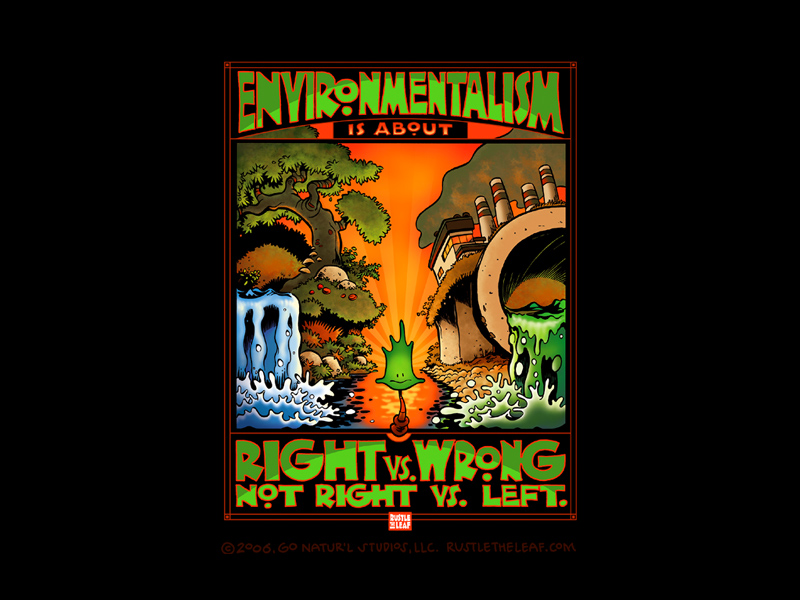
Staying with politics, Justin presents Republicans vs. Democrats: Our Political Downfall posted at Politics & Religion. The points he makes apply to the UK just as well as the USA, and probably other countries, too. Combative party politics seem to work to the detriment of people and the natural environment. Reminds me of the Rustle The Leaf poster - the environment's not about right vs. left, it's about right vs. wrong.

Harlan of Greener Magazine thinks that using the Internet, particularly blogging, is becoming an increasingly common method for elected officials and public agencies to communicate with constituencies. But, he asks, at what cost?

And David of Ecolibertarian is frustrated by the clumsiness of government attempts to encourage lower–carbon-emitting lifestyles and business practices in Britain, as he expresses in his post Small is Difficult.

Eco-Living

Tiffany at
Natural Family Living Blog writes about a subject close to my heart: organic can be affordable. I'd also add to her excellent list that growing some of your own fruit and veg, and keeping backyard chickens are excellent ways to eat organic cheaply.

Also in the domestic sphere, Tracy at EcoStreet wants you to
Give your bathroom a green makeover. "Whether you are planning a complete bathroom overhaul, or just want to make a few inexpensive changes, we can help you make your bathroom an altogether more eco-friendly place". Preston at Jetson Green has three suggestions for greening your property's energy mix. And Mark at HotStrategies asks what makes green furniture different from conventional furniture?

I really love Shannon's Ten Great Reasons To Buy Something Used, over on Saving Advice. She's a woman after my own heart.
And check out Mallory's article over on Miss Malaprop about recycled jewellery and other items which she refers to as "Trashion".

Doug of Doug Green's Garden submitted an online seminar about taking care of lawns and gardens using only organic techniques. That's right up my street, Doug - organic isn't only for growing fruit and veg, it's a way to garden in harmony with nature, to the benefit of plants and animals and ourselves. For example domestic pesticide use can be a threat to birds who eat the poisoned bugs; The Blue Voice reports that many of Americas common birds are declining, in the post Losing the Birds. John of A DC Birding Blog notes the same phenomenon, which he attributes to new housing developments.

Also in the garden, Veggie Revolution reports that beekeepers have struggled as hives have failed soon after the bees embark on their pollen-gathering season. In what has become known as “colony collapse disorder,” honey bees leave the hive and don’t return. I've been following this story as I'm hoping to collect two hives of honeybees next weekend, so thanks for that.

Sustainable Communities

Alex submitted the article Ecovillage Update from the Generation Exe blog, about an ecovillage community in the San Mateo/Foster City area. "The community has a shared organic garden, fruit trees, chicken, and a solar PV system, The project was created by Sanda and Brian and they are involved with different organizations in the bay area and have been nominated for a sustainability award by the Green Party of San Mateo". Sounds blissful. Thanks for sharing this, Alex.

Maybe Alex's post provides some answers to the questions Lisa asks in her
article Seeking A Sustainable Human Society over at The Christian Environmentalist. What is the best way for humans to live? What balance between human and natural resources, between space and society, is ideal for the sustainability of a human community?

At Money Changes Things there is a report about two communities which have banned plastic bags. That seems to be a good way to go. And Leon of Sox First has noticed that investment in sustainable energy is climbing to record levels on the back of concern over climate change, high oil prices and growing government support

I hope you enjoyed the carnival, whether you're a regular Bean Sprouts reader or a visitor. I certainly enjoyed hosting it. And I hope you'll come back and visit Bean Sprouts again.

Sunday, July 01, 2007

Drive Slower Challenge Results

42 people voted in the Drive Slower Challenge poll, which I think equals our most popular poll so far, the January 2007 Green and Clean challenge. The results this time were:


  • I've gone green! I pledge to drive slower! 14 votes
  • I was already green! I always drive slowly! 12 votes
  • I don't want to! I'm a screaming speed demon! 5 votes (shame on you!)
  • I'm greener than thou! I cycle everywhere! 11 votes
A new challenge for July will be posted soon.

Happy birthday to my dad, Bill, by the way, who is visiting us for a few weeks. And one last thing - Rustle the Leaf appears to be on hiatus, so our Sunday comic strips are coming instead from Throbgoblins.

Saturday, June 30, 2007

Bee Jokes

Since we're posting bad bee jokes...

Knock knock
Who's there?
Abbey
Abbey who?
A bee just stung me!

Knock knock
Who's there?
Anna
Anna who?
Another bee just stung me!

Knock knock Who's there?
Helen
Helen who?
Hell, another bee just stung me!

Friday, June 29, 2007

Eric and the Bee

I've been trying to post a YouTube clip of a classic Morecambe and Wise sketch, Eric and the Bee. But YouTube isn't playing ball, so here's the link: http://www.youtube.com/watch?v=EztaBXod2no&NR=1

Knowing my luck six blog posts will appear in two hours' time of the clip I was trying to post...

Thursday, June 28, 2007

Review - Keep Chickens

Keep Chickens! by Barbara Kilarski was the book that got me started with chickens. It's by Storey Press, who publish books about gardening, soap-making, brewing, livestock etc. I've never had a bad book from them.

The book is specifically aimed at backyard chicken-keeping, not smallholding or farm scale poultry. It answered all my questions about keeping hens in a domestic garden - noise, smell, housing, hygiene etc. I've found the information in the book to be practically sound and based on experience and expertise, although it is an American book and so not all the advice was strictly relevant to a British reader. But even if American living habits sometimes differ from British (what is a condominium anyway?), American chickens seem to be identical to their Limey counterparts so the differences weren't very important.

As well as the factual information, I was charmed by the illustrations. There are several colour plates including images of different breeds of chicken and some quirky hen houses. The black-and-white pages of the book are also peppered with 1940's American ads for poultry feed, which give it a fun, retro feel. Also charming is the writing style; Kilarski writes from experience and includes lots of anecdotes about her three "girls". By the end of the book you feel as if you're personal friends with Zsa-Zsa, Whoopee and Lucy.

I've already written about why (almost) everybody should keep chickens. If you're thinking about it, I'd recommend you start by reading "Keep Chickens!" (and of course my series of articles about getting started with chickens, part 1, part 2 and part 3).

Wednesday, June 27, 2007

Lemon Curd


I made some lemon curd using Hedgewizard's recipe. Thanks, Hedgie, it's delicious and sooooo easy - you all must try it. Suitable for the preserve-challenged; forget massive cauldrons full of boiling hot jam, special thermometers and getting the whole kitchen covered in sticky goo. The whole process takes about 10 minutes from thinking "Hmm, maybe I'll make some lemon curd" to admiring your finished jar of golden yumminess. Plus it uses ingredients you probably have knocking around anyway - lemons, eggs, sugar, butter and cornflour. Finally, there's no problem with small batches. Just make a single jar if that's all you need.

Recipe for lemon meringue pie coming soon...

Tuesday, June 26, 2007

I've Got a Bike

Isn't Freecycle wonderful? It's the network of local groups where people post adverts offering stuff they don't need anymore and other people come and take it away. It was first described to me as "like eBay, but free". I love it.

At the weekend I collected bikes for me and Tom. Many thanks to Kate from Levenshulme and Mary from Whalley Range (fab house, by the way!) Sam can have Tom's old bike, and I'm still looking out for a bike for Ellie. If I can't find one on Freecycle before the summer holidays I'll have to buy one, but I don't mind. We've done very well to get so many bikes for nothing. Come to think of it, Ed's bike was a Freecycle find as well.

Monday, June 25, 2007

Drive Slower, Cut Carbon Emissions

How are you getting on with the Drive Slower Challenge? 33 people have voted so far and there are still 5 days left until the poll closes. If you want to vote, the poll is in the right-hand sidebar.

Why do I want you to drive slower anyway? Well, it's safer, and it saves fuel which saves you money, but mainly because it reduces carbon emissions. Some of you may be well-versed in the whole carbon issue, but I suspect many people are still kind of fuzzy on what it's all about. So here is:

A (VERY) BRIEF HISTORY OF CARBON

Carbon dioxide is a natural part of earth's atmosphere, even though only in tiny amounts (4 parts in every 10,000). But it's the second most important greenhouse gas. That means it has a huge effect on the atmosphere's capacity to retain heat, trapping energy in our atmosphere.

It's not the most important greenhouse gas - that would be water vapour. The amount of water vapour in our atmosphere isn't changing. But the amount of carbon dioxide is, because in recent human history we have burnt off massive amounts of coal and oil and natural gas - fossil fuels. I'm sure you remember from school science lessons that fossil fuels are formed from prehistoric living organisms, such as animals and plants, that got trapped under rock and buried deep under the earth. This sealed away enormous amounts of carbon and stored it up for millions of years. But in just the last hundred years we have dug most of it up and burned it, releasing it into the atmosphere again.

GLOBAL WARMING? BUT I FEEL COLD!

All this extra carbon dioxide increases our atmosphere's capacity to store energy. Overall, this means global temperatures are rising. But locally it can mean warming or cooling, more rain, or drought. It means the disruption of familiar patterns and weather chaos. Some sceptics gets their knickers in a twist about this, but it makes sense. My friend Jim Finnis once explained that the climate is a bit like a child's swing. If you put more energy into it, say by giving it a hard shove to the left, you don't expect it to just move over to the left and stay there. You expect it to swing about more, both more left and more right. More energy means more everything. Just more weather.

SO WHAT CAN I DO ABOUT IT?

Good question. I feel really strongly that we can't dither about and wait for someone else to fix this for us. I hope that governments will do something to fix it, but that will only happen if the voters demand it. I hope that businesses will do something, but that will only happen if stockholders demand it. I hope that scientists will find more solutions to it, and they are doing that. But we already know the solution - every one of us has to take responsibility for emitting less carbon dioxide.

Driving slower is one way to start.

Sunday, June 24, 2007

How To: Make a Lacewing Shelter

Do you remember when garden centres just used to sell gardening stuff? Now they sell everything from hand cream to cream teas. They seem to do a roaring trade in wildlife shelters, like mason bee boxes, ladybird houses, and bug blocks. I'm really glad that more people are taking an interest in our native wildlife, and trying to help them along. But at the risk of upsetting Wiggly Wigglers again (just teasing) you can make most of these things yourself out of recycled materials.

Here's how to make a lacewing shelter (why would you want to make a lacewing shelter? because lacewings are beautiful, and also because their larvae gobble up aphids like there's no tomorrow).

You will need some corrugated cardboard, an empty fizzy drinks bottle, scissors or a craft knife and some twine.

First of all rinse the fizzy drinks bottle and cut the bottom off. Leave the lid on, otherwise rain will soak the cardboard.

Then cut a strip of corrugated cardboard slightly shorter than the length of your bottle. It's important to cut it across the corrugations, not along them. This is the hardest direction to cut in. So if you're finding it very easy to cut, you're probably cutting it the wrong way.

Score a few lines close together at one end of your strip to make it easier to roll up. Then roll the strip really tightly.

Jam it into the fizzy drinks bottle. It needs to be a really tight fit. If it isn't, add more strips of card until you have a nice tight fit.

Tie some twine around the neck and hang it up. Lacewings will shelter inside. You can change the cardboard once a year if it gets ratty.

See? Easy. But if you don't want to make one you can buy ready-made bug habitats from Wiggly Wigglers, who are very nice people.

Saturday, June 23, 2007

Famous Allotmenteers

Did you know Albert Einstein had an allotment in the Kolonie Bocksfelde in Berlin-Spandau in the early 1920s? It seems he wasn't a very assiduous allotmenteer, because he was sent a note by the local authority taking him to task about the state of his plot:

You are presently leasing allotment 2 at the Burgunderweg in Boxfelde. Said allotment has not been managed since a long time, weeds have spread all over the whole parcel and have soared. The fence is not in order, and the whole allotment makes an unesthetic impression. We have to assume that you are no longer interested in leasing the parcel, and we will give it away to someone else, unless you object prior to the 25th of this month, and the allotment is put in order until that date. Please take care of the removal of this nuisance, and give us further notice.

So that's two things I feel good about - I'm a better allotmenteer than Einstein and I'm probably a better physicist than Monty Don.

Friday, June 22, 2007

Bee Hives

I collected some empty bee hives from a nice woman I met at the apiary meeting. I also collected a travelling screen from the nice chap I met at the same time. I'll need these hives to move Ally's WBC hives, because apparently you can't just move a WBC hive, you have to transfer the bees into a National hive first.

Just to keep things complicated.

So now I'm off to spend a happy hour going over the hives with a blowlamp to sterilise them.

Thursday, June 21, 2007

Happy Solstice

It's midsummer day[1]. Today is the longest day, and tonight will be the shortest night of the year. The sun reaches its highest point in the sky at midday today, and hangs motionless at 6 minutes past 6 this evening with minimal north or southwards motion. It's a magical time of year.

I hope 2007 has been good to you so far, and will continue to be so. Enjoy this special day.


[1] In the northern hemisphere. If you live in the southern hemisphere it's midwinter. And if you live on the equator it's just another day, hot, with a high chance of thunderstorms later.

Wednesday, June 20, 2007

Washing balls

I tried a different kind of washing ball from Lakeland. They're just heavy plastic balls that agitate your clothes in the machine and bash the dirt out of them.

I wish I had some way of telling whether clothes are cleaner, or wear out quicker, or fade more, depending on what type of washing additive you use. But in absence of a scientific method here are my findings about eco-laundry:
  • Using laundry detergent gets your clothes clean
  • Using "eco" laundry detergent gets your clothes clean
  • Using soap nuts gets your laundry clean
  • Using "eco balls" gets your clothes clean
  • Using heavy plastic washing balls gets your clothes clean
  • Using nothing at all gets your clothes clean - even when all the residual detergent has been flushed out of your machine
In conclusion - that whole aisle of the supermarket selling dozens of different types of laundry detergent, liquids, tabs, softeners, bleaches, stain removers, wash additives - it's all a con. Unless your clothes get unusually grubby - if you are weaning your baby and his clothes are regularly covered with spaghetti hoops, if you are a smallholder and your clothes are often caked with mud and pig dung, then yes you may need to use detergent for those washes. But I've found it's not necessary for most "normal" washes.

I wash all my clothes on 30 degrees with plain water and no detergent. Most stuff comes out clean. Some things need a rub with some kind of stain remover and washing again - but that also happens when you use detergent. Dry things outdoors when you can. Not only does it save energy, but the sunlight whitens clothes and kills bacteria (if you're worried about bacteria).

Tuesday, June 19, 2007

How To: Perk Up Your Houseplants

Some of my houseplants were looking a bit sorry for themselves, so over the weekend I gave them a bit of TLC. Here's my procedure for houseplants.

1. Compost any that are dead, crispy, or in any other way a basket-case. Feel guilty. Promise yourself you will remember to water/not to overwater them in future. Make a list of the species that died and remember never to buy that type again.

Half the secret of success with houseplants is to quickly get rid of any that are dying and look terrible.

2. Gently tip each surviving houseplant out of its pot to see if it needs repotting. If it does, the roots will be thick and visible, tangled inside the rootball. If you can see mostly soil and only a few fine roots, it's probably OK where it is. Remember which ones need repotting.

3. Put a couple of inches of water in the bath with some plant food. Stand all the houseplants in the bath, and gently mist them with the showerhead, so the soil gets wet from the top and the bottom. After an hour or so they should all be feeling much perkier.

4. Repot any plants that need it. Just find a slightly bigger pot, put a little potting compost in the bottom and carefully place the rootball on top. Fill in the gaps with more compost, and put a layer on top, firming it down with your fingers. It's important to give the plant a really good drink, but I don't usually bother with teasing out the roots. The roots seem to manage to grow outwards in their own time.

5. Snip any brown, dead leaves and rotten flowerheads off the plants. My mum used to cut the brown ends off spiderplants, and then trim them back to nice points. She called it "giving them a haircut". She could be a bit odd sometimes...

6. Occasionally when you trim a plant in this way, it only has three or four healthy leaves left and looks rather tragic. In these cases I tend to make cuttings. Snip off the healthy leaves with their stems, or sections of the plant, then push them into small pots of damp potting compost. You can compost the stem and rootball. With luck they will begin to root. You can't tell - don't pull them up to see if they have or not. If they die, then they didn't root, and if they stay alive, well they must have rooted. In a while they will start putting out new leaves and grow. Voila - several new healthy houseplants from one ailing houseplant!

7. You can also take cuttings of any plants which are healthy and thriving, of course, and this is an excellent idea. The other half of the secret of success with houseplants is to learn which varieties thrive under your own conditions and combination of neglect/overattention. Then specialise in that variety. Everyone will say "Oh, she's terribly good with begonias (or whatever)", and they don't need to know that begonias are the only things that survive in your house. Tip: spider plants are almost indestructible.