In October or November my dad ordered me a kit from Marshall's for growing potatoes in bags. His intention was that I would have home-grown potatoes for Christmas. But the kit only arrived a week or so ago, so today Steph and I planted them up, with some help from Eleanor and Rebecca.
You put about 8" of compost in the bottom of the bag then put three chitted spuds on top and cover with about another 4" of compost. Keep it watered, and as the shoots appear you cover them with more compost until the bag is full. I've had friends who used this method and they were amazed at the size of the crop. They told me the bag is just jam packed full of potatoes by the end.
The kit came with three bags and fifteen Swift seed potatoes. The instructions said to put three spuds in each bag, so we jabbed some holes in the bottom of a half-empty compost bag and planted that up as well. There's nothing magic about the bags that Marshall's sent me - you can grow spuds in any sack or bag or bucket of roughly the right size. The only "magic" is that receiving a kit through the post gave me a kick up the behind to actually do it. Thanks, Dad.
Showing posts with label gardening. Show all posts
Showing posts with label gardening. Show all posts
Friday, February 20, 2009


Friday, February 13, 2009
Back to the Allotment
Ed and I went back to the allotment today for the first time in 2009. We were almost scared of what we would find, and it certainly looked weedy and neglected when we got there. But we harvested some leeks and some borecole (a curly cabbage-related thing). And we found most of the weeds were shallow, surface-rooted things which came up very easily. In an hour and a half we had cleared about an eighth of the whole plot, which is very encouraging.
I'll go back later in the week and plant something in the ground we cleared. Broad beans and garlic can go in at this time. And we'll return once a week to clear a bit more. By the time spring really gets started we should have it all shipshape.
I enjoyed myself enormously. I had forgotten how much I love going there. It helped that it was a beautiful day. The sky was blue and the sun was shining, although there was an inch of ice in the water butt. But after only a short while of digging we had stripped off our layers of woolies and were in our shirtsleeves. I chatted to one of the allotment holders who filled me in on what had happened since I was last there. I took stock of what is still there - my soft fruit bushes, my apple tree, the rhubarb is already coming up and so are the daffodils. Ed and I planned what we would plant in the coming season.
It's good to have dirt under my nails again.
Wednesday, May 28, 2008
Urban Permaculture in Havana
Thanks to Marc Roberts and via Celcias, this wonderful video of sustainable urban food production.
Tuesday, May 20, 2008
Jungle Clearance - Before and After

As promised - "before" and "after" shots of the scary jungle area. There's still more work to do - more manure to shovel over all the plack weed supressing membrane, the final strip in the background still to be strimmed, cleared, membraned and manured, and then we can plant all our pumpkins and squash in it. But we've made a heck of a lot of progress already and it's looking much better.

Sunday, May 18, 2008
Jungle Attack Plan Update
Quick update on the Jungle Attack Plan: We hired a strimmer (aka weed whacker) on Saturday and attacked the weedy 14 yard x 10 yard jungle on the allotment. We took down a fence that used to separate the two parts of the plot, and hacked about 90% of the weeds. But we shattered two strimmer blades in the process, and could not continue because we had no more blades.
We changed the plan a bit; we're no longer going to rotavate. Instead we laid weed supressing membrane over the cleared areas and heaped several inches of manure on top. Thanks to everyone who commented for all the jungle clearance advice. The membrane cost less than hiring a rotavator, and ought to be less work as well as more reliable at clearing the area.
I shifted 30 wheelbarrow-loads of manure today, and there's still lots more to do. There's still plenty of manure so that's no problem. I'll go to the allotment every day and pile on as much more as I can. Next weekend we'll hire the strimmer again and finish the job. As soon as the squash plants are big enough, we'll plant them out.
I took some "before" photos, but I didn't take my camera today so I have no "after" photos. I'll get some soon and show you what we accomplished. It's an amazing transformation. I feel knackered, but very happy.
Saturday, May 17, 2008
Review: Grow Vegetables
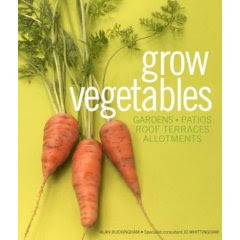 Dorling Kindersley very kindly sent me some books to review. I'm very glad to receive free books. I'll also review CDs, chocolate and wine if anyone wants to send me some. One of the books they sent me was Compost by Ken Thompson, which I reviewed in March. The other is Grow Vegetables by Alan Buckingham.
As you'd expect from a DK book, the photography is gorgeous and the design is attractive and easy-to-use. Throughout the book, the author has borne in mind the different situations people might want to grow vegetables, from an allotment or a large garden down to a small veg patch in an ornamental garden, a patio, balcony or windowsill. There is something for everyone here, although if all you have is a windowsill you may prefer to borrow the book from the library rather than pay £16.99 for it.
The book seems to be aimed at beginners. For example it includes some extremely basic stuff, such as what does a hoe look like and what is it used for. That's a good thing - we all had to learn at some point, whether at our granddad's knee or from a book at a more mature age. All the basic stuff is covered in the first couple of chapters, titled The Perfect Plot and Vegetable Grower's Know-How.
After that it gets down to business, with sections dedicated to Cabbages and Leaf Vegetables, Root and Stem Vegetables, Peas and Beans, Salads, Fruiting Vegetables, Cucumbers and Squashes, Perennial Vegetables and Herbs. I think that's a very sensible way of dividing them up, collecting together types of vegetables that are cultivated in similar ways. It's better than putting them in alphabetical order as so many books do. That way runner beans, climbing French beans and dwarf beans are all in different places. If you want to look up a particular vegetable by name, there is a comprehensive index in the back of the book.
Within the chapters, each vegetable has a photograph, a description and instructions of how to grow it, and a little chart showing the "season". This shows you when to sow, transplant, and harvest the veg, but it only splits it into spring, summer, autumn or winter, rather than telling you the month. I think I understand the reaosning - not everyone lives in the same growing zone. I know that Stonehead in Aberdeenshire has a shorter growing season that we do in North Cheshire, whereas Stuart and Gabrielle of Permaculture in Brittany have rather longer. But I feel that just stating the season rather than the month is so vague as to be pretty useless. Almost all the vegetables say "Sow in spring, transplant in summer, harvest in summer or autumn". Well, duh!
However all is made up for in the following chapter, Vegetable Year Planner, which gives a month-by-month rundown of what to do in the vegetable garden each month. The final chapter is the inevitable Vegetable Doctor. It's the scary one with all the pests and deficiencies and diseases that might strike, very sensibly left to the end so hopefully it won't put anybody off.
The bottom line? I don't think I'll be offering this book as a competition prize, I think I'll be hanging on to it. That's probably the best review I can give.
Monday, May 12, 2008
Top Ten Compost Systems
 As part of our Composting Challenge, Bean Sprouts presents the top ten composting systems.
1. Pile up organic stuff in a heap and wait
PROS: cheap, easy, effective
CONS: takes up space, quite slow
2. Build a compost box, either make your own or buy it like this one from Wiggly Wigglers.
PROS: more aesthetically appealling than a heap
CONS: they can be quite pricey if you buy them, you need a suitable spot in your garden
 3. Plastic compost bin, aka "dalek". You might be able to get a free or subsidised one from your council, visit the RecycleNow website to find out.
PROS: even tidier than a compost box, quite compact
CONS: you still need a garden or at least a patio
4. Tumbler, such as this one at Just Green.
PROS: supposed to be faster than a dalek, sounds quite good fun
CONS: space again, and are they easy to turn when they're full or do you have to be quite strong?
5. Green Cone
PROS: can compost cooked food, meat or fish, bones, dairy products which other composting systems can't deal with
CONS: They're not cheap, you need a garden with some earth as half of the system is buried underground.
 6. Leaf mould composting. There's a video about it here
PROS: make something useful out of fallen leaves, very easy
CONS: you need enough leaves to start with, takes a long time
7. Bokashi, an effective microorganism (EM) that speeds up composting incredibly. Here is the system sold by Wiggly Wigglers
PROS: very quick, can compost in a sealed bin indoors
CONS: cost, you have to keep buying the bran impregnated with EMs.
8. Trench composting - basically fill a trench with organic waste, cover it over, and plant on top. There are instructions on how to do this at Instructables
PROS: Cheap, you can combine this with the bokashi method by adding some EM impregnated bran to the trench to speed up composting
CONS: All that digging is hard work, you need a garden you're willing to dig up so maybe not suitable if all you have is lawn and flowerbeds
9. Wormery, such as these from Wormcity
PROS: some systems are suitable for indoor use, good if you don't have large volumes of compostable waste
CONS: if you get it wrong the worms can die, some people are squeamish about worms

10. Compost toilet, like these from NatSol
PROS: recycle your own humanure, modern ones look just like normal toilets
CONS: A lot of people might feel this is a step too far, you've got to remove the compost at the end of the process
If you decide to try one of these methods, please vote in the poll in the right hand side bar.
Friday, May 09, 2008
Celery
 I've never grown celery before, but apparently this is how you do it. It needs support, so you sow it in three-feet-square blocks with a cane at each corner. You wind string around in this pattern. Then you can plant nine celery plants and they will all get support from the string. You can add more string higher up as it grows.
I've searched the internet, and I can't find anywhere else it recommends doing this. But this is the method told to me by my allotment gardening guru, so I'm going to stick with it and see how it turns out.
Thursday, May 08, 2008
Rhubarb Flower
 Did you know that rhubarb has flowers? I didn't. It makes sense - most plants have flowers of some kind. Generally, gardeners like flowers on plants where you eat the fruit or the seeds. But they don't like them on plants where you eat the leaves, stem or root. Once a plant has made flowers and set seeds, it stops putting energy into the other parts of the plant. Last year some of my onions did it, and when I cut up the onion bulbs they were all hollow in the middle. So gardeners are alert to plants "bolting" (it means making flowers, often on the end of a tall stalk), and the chop the flowerheads off when they see them.
I've never seen rhubarb flowers before, but this year rhubarb is bolting all over the allotments. It could be that the weather conditions are right for flowering rhubarb. But I've long had a sneaking suspicion that bolting plants send some sort of chemical signal to their fellows. When you let one go, they all start. Of course, that would also happen if they were all responding to the same weather conditions. What do you think? Is my "chemical signal" theory just rubbish, or is there something to it?
Anyway, the wonderfully phallic rhubarb flowers had to get the chop. I winced when I did it, but they had to go, or they would have sapped the plant and I wouldn't get any lovely pink rhubarb to eat and make chutney out of.
Wednesday, May 07, 2008
Recycled Plant Markers
There's lots of ways to make recycled plant markers. I'm always baffled why you can buy them in the shops. Who would pay money for rectangular bits of plastic?
 I've used yogurt pots, plastic milk containers, ice cream tubs, but this time I used an old margarine tub. You'll also need some scissors and a marker pen.
 Cut down the sides of the margarine tub to get lots of short plant labels suitable for plant pots. If you want longer labels suitable for the garden or allotment, you could cut down one corner of the tub, then cut horizontally. Or you could use a bigger container to start with.
 When you have made lots of vertical cuts, snip all your rectangles off along the bottom.
 You can use the bottom of the tub, too. Just cut it into strips.
 Trim one end of your label into a point to make it easier to push it into the earth.
 Make sure you write with a permanent marker. It's really annoying if the plant names when you water them.
Saturday, May 03, 2008
Starting to Look Like a Proper Allotment
 Well so much for the weather forecast. I went down to the allotment before 8am in case it rained later, but it stayed dry all day. At 10am I came back and picked up the rest of the family and we all stayed on the plot until 5pm. We weeded the garlic. It's looking good - I'm really keen for the harvest. I helped Eleanor plant her part of the allotment with sweet peas, pansies, violas and other multicoloured flowers. She didn't want anything edible in her part of the plot, just flowers.
We weeded, dug and manured a scary weedy area full of ground elder and dock. We sowed peas, planted cabbages, celery, and Jerusalem artichokes, and created an area for Tom. He wants to grow carrots, strawberries, blackberries and bananas. I asked him if he wanted any flowers, but he doesn't.
It doesn't sound much when I write it down, but we must have put in 15 back-breaking man-hours. I've caught the sun on my arms and the back of my neck. Ed says it's starting to look like a proper allotment.
Tomorrow if the weather stays good we'll weed the soft fruit and tackle another scary weedy area. I've still got some red cabbages and some onions (red and white) to plant, and I want to sow my runner beans. That will be the whole of the "old" part of the allotment, leaving only the new area to do. If some of the bits we've got now are scary weedy areas, that part is a terrifying jungle, but I'm determined to tame it this bank holiday weekend.
Friday, May 02, 2008
Gardening Leave
 "Gardening leave" is usually a euphemism for someone being suspended from their job. But Ed actually took a day of his precious holiday time to work on the allotment.
We dropped the kids at school at 9am, and then spent all day at the plot. At 3pm I collected the kids from school whilst Ed remained on the allotment for another hour. Then we swapped shifts and I stayed on digging for another couple of hours. All told I think we did about 12 man-hours today.
We weeded about half the area we had last year (we have a new bit - a scary jungle to be tackled later). We dug and manured the bare areas and planted leeks, carrots, curled borecole, calabrese, purple sprouting broccoli, cauliflowers, and French marigolds. Yes I know it's supposed to be tagetes for companion planting, but I couldn't find any. And the main reason I wanted them is that I resolved to have more flowers on the plot, just for pleasure, so French marigolds are as good as anything.
We weeded amongst the overwintered shallots and broad beans, so now we can see how well they're coming along. We weeded and tidied the herb bed and planted some bronze fennel and rosemary for height at the back.
We strimmed the green manure I planted in late autumn and Ed dug it it. Ed says he does not like green manure, simply because he does not like the "digging it in" part. If anyone wants to tell us that part is not necessary, we'd be pleased to hear from you. In any case, there is an enormous pile of the brown sort of manure and we made good use of it, so the green type seems unnecessary.
Fortunately the weather remained glorious all day. The forecast says heavy rain over the weekend, although Monday (a bank holiday here in the UK, and the reason for Ed's non-euphemistic gardening leave) is forecast to be fine. We'll see. When it's fair, we'll garden, and when it's pouring, we'll do something else. When you put it like that, the forecast is neither here nor there.
Tuesday, April 29, 2008
Zen and the Art of Mowing the Lawn
 When I got the lawnmower out for the first time this year I had to spend half an hour cleaning the grass that was firmly glued to every surface. Last year was a horrible washout and we eventually had to mow the lawn when it was wet, because it never dried out at all and it would have been knee-high if we hadn't mowed it sometime. The wheels of the mower ground up the spongy, waterlogged soil, damaging the lawn. The wet grass didn't cut very well, especially the tough stalks which had developed in the long period between mowing. The soggy grass cuttings stuck to all parts of the lawnmower and were difficult to clean off; eventually we gave up trying. Mowing the lawn in 2007 was a miserable experience.
But last Saturday, ah, that's a different story. I had forgotten the simple pleasure of cutting the lawn with a properly functioning mower on a warm dry day. The hum of the mower, the delicious sharp smell of the cut grass, the birdsong in the distance, the heat of the sun on my back. I felt as though I could have mowed forever. Then sitting down with a cold glass of beer afterwards and surveying a job well done. Heaven must be just like this.
It was during this "surveying" period that I noticed various nasty holes and patches in the lawn. Sam helped me fork out the weeds and moss, prepare the soil surface, and sow some new grass seed to fill the gaps. On Monday he brought home a small scarecrow he had made at school. There was really only one place to put it. Sam's scarecrow stands in the middle of the front lawn, deterring any birds who might want to eat our grass seed before it grows.
Friday, April 25, 2008
Little Black Flies on Houseplants
 Do you ever get those nasty little black flies on your houseplants? Clouds of the buggers fly up whenever you disturb the plant. They're really gross.
They're called sciarid flies, fungus gnats or mushroom flies. And you've only yourself to blame; they eat rotting vegetable matter, such as the rotting roots of your chronically over-watered houseplants. The flies don't do any damage to your plant. If an infected plant dies it's usually from the over-watering that attracted the gnats in the first place. The flies are the symptom, not the cause.
Fortunately, the treatment is simple and completely organic. First of all let the poor old plant dry out. It won't harm the plant to do this, in fact it will probably do it a power of good. But mainly you're trying to disrupt the gnats' life cycle. The eggs take about a week to hatch, so if you can keep the soil dry for a couple of weeks you should be able to kill the already-hatched larvae by desiccating them, any larvae that hatch from the eggs after a week will also desiccate, and the adults will have no rotting roots to feed on so they should die too. So you can see that two weeks of dryness should sort the problem out.
If you feel you need an extra line of attack you could get some sticky yellow traps from your garden centre. I don't think they have a proprietary name, just ask for "sticky yellow fly traps for houseplants". These attract the flies - apparently it's the yellow colour that attracts them, not any chemical or scent or anything. And the stickiness is just glue that sticks the flies down and traps them - there's no pesticide in the traps. So this is an organic approach that should help get rid of the nasty little blighters.
Once you've eliminated the flies you might want to put a physical barrier on top of the soil to deter them coming back. An inch-thick layer of sand or fine gravel will prevent females from laying their eggs in the soil.
Finally - STOP OVER-WATERING YOUR POOR PLANTS! Always feel the soil before you water them and if the soil is moist then don't add any more water. Don't let the plant sit in a saucer full of water all day, or worse still for days and days. If there is water in the saucer half an hour after watering, pour it away. Different plants need different watering regimes, so don't water all your plants at the same time. If your moisture-loving Boston fern is looking crinkly round the edges then give it a drink, but you shouldn't water your drought-tolerant Easter cactus at the same time every time. Plants in great big pots need less frequent watering than plants in little pots, although obviously they need more water each time.
Good luck with the sciarid flies, if you have them. And if you don't, give yourself a pat on the back for not over-watering your plants.
Saturday, April 19, 2008
What's New in the Sustainable Blogosphere?
For the last two weeks I have been too busy to keep up with my emails and blogging, and now I'm catching up. Here's a few of the things that landed in my mailbox that I thought worth sharing with Bean Sprouts readers.
Earth Day
First of all, this coming Tuesday is Earth Day. Earth Day has been going since 1969, but the time is right for it to really take off. I'd love to see it become bigger than Christmas (which is a religious feast for Christians like me but tends to be just an excuse for an orgy of over-consumption and wastefulness for, well, for Christians like me and everyone else as well). Earth Day is for everyone who lives on Earth. You'd have to be living in a cave not to notice Christmas when it comes around. Earth Day should be the same. Every time you buy a calendar or a diary it should have Earth Day marked on it already. So do something. Spread the word. Send an e-card. Give gifts of LE light bulbs and organic wine. Invite friends around for a meal of local food, obviously. Blog about it. Spread the word.
Swaptree.com Donates to the Sierra Club
In honor of Earth Day this Tuesday, Swaptree.com, the website where you can trade the books, DVDs, CDs, and video games you have, for the ones you want, for free, will be donating $1 dollar for every trade made on Earth Day to The Sierra Club. Swaptree is like Ebay but cash-less. British readers of a certain age will remember Noel Edmonds' Multicoloured Swap Shop which used to be on TV on Saturday mornings. Young viewers would send requests to swap a Bay City Rollers scarf for an Action Man with eagle eyes and so on. Swaptree is much swankier - you type in the bar code of the book, CD, DVD or video game you have and the clever Swaptree software figures out 2-way, 3-way and even 4-way swaps that mean everyone gets the things they want. You don't pay Swaptree for the privilege. It doesn't cost you anything apart from postage, and Swaptree can calculate the shipping cost and print out a mailing label so you don't even have to go to the post office. You give and receive feedback so you can feel confident you won't be ripped off. There's a video tour so you can see how easy it is. But sadly it is only available in the United States at present. As soon as it comes to the UK I'll be the first to sign up.
Penguin Classics Partners with The Nature Conservancy
Staying with the topic of books, I have some news about one of my favourite publishing imprints, Penguin Classics. On April 1st, 2008, Penguin Classics began their support of The Nature Conservancy's ambitious reforestation plan to plant and restore one billion trees in Brazil's Atlantic Forest.
In bookstores everywhere, bookmarks (printed on recycled paper) featuring three of Penguin's favorite environmental classics, Rachel Carson's Under the Sea Wind, John Muir's The Mountains of California and Ralph Waldo Emerson's Nature and Selected Essays, will encourage readers to visit The Nature Conservancy's website, donate a dollar and help plant a billion trees.
There's more information about this partnership here.
Downshifting Week
International Downshifting Week starts today. Yippee! Thanks to Rebecca from Sallygardens for the reminder. Last year it was just National Downshifting Week, so it's growing fast. Visit the website for ideas of how to take part, including:
Take Back the Filter
The indomitable Beth Terry from FakePlasticFish has started a new campaign to urge Clorox (the company that owns Brita in North America) to take responsibility for the millions of plastic Brita water filter cartridges that are disposed of each year. It's called Take Back The Filter and has its own homepage. Here in the UK we can recycle our Brita cartridges. The FAQ page of the Brita UK website says:
And the recyclenow.com Top Tips at Home webpage says:
So once again this is more relevant to US readers than to our home grown readers. But the Internet is an international medium and I'm glad to support Beth's campaign.
This Bill's Got No Balls
Here's one specifically for UK readers, though. 'This Bill's Got No Balls' - the new short film from I Count - follows three hilarious scenarios where the protagonist, Bill, confronts three eyewatering situations - on the football pitch, in the office and on the street - that clearly demonstrate that he's lacking a sensitive part of his anatomy. Click here to watch the film.
Viewers are encouraged to visit the I Count website, from where they can put pressure on their local MPs to vote for a Climate Change Bill with balls when the new law is voted on in the summer. The film can also be viewed on myspace and facebook so please feel free to forward it to your friends.
Mathew Horne - of BBC3's 'Gavin and Stacey' who provided the voice over for the film - said:
The Broke Vacationer
Sally Thompson of TravelHacker has written an article called The Broke Vacationer: 100 Ways to Get Free Stuff When Traveling. I like some of the frugal tips in this article, although I don't really want to encourage people to fly all over the world on their holidays. Have a look at the article and decide for yourself which of the tips fit your own ethical values and which you might prefer to pass.
Home Gardening Tips
Bill Stanley, author of Home Gardening Tips, got in touch to ask if he could add Bean Sprouts to his blogroll. Bill has been a home gardener for over 20 years and enjoys sharing his gardening tips with friends and family as well as the rest of the world. As well as tips on plants and gardening, Bill has recently added articles about saving the environment whilst gardening, buying flowers online and those slimy little buggers, snails. Just for the record, I'm always delighted when anyone adds Bean Sprouts to their blogroll, or links to Bean Sprouts in a blog article. You don't need to ask permission, but if you do I'll check your blog out and maybe write about it, just like this! So email me and say hi.
We Dig for Victory
Rob Burns has built a mini campaign site called We Dig for Victory. He has created a little sticker and his website says:
There's a bit more about the campaign on the page titled About This Site. Why not add the sticker to your own blog or website and spread the word?
Thats it, I'm all caught up with my emails now. I only wish the same were true of my laundry.
Earth Day
First of all, this coming Tuesday is Earth Day. Earth Day has been going since 1969, but the time is right for it to really take off. I'd love to see it become bigger than Christmas (which is a religious feast for Christians like me but tends to be just an excuse for an orgy of over-consumption and wastefulness for, well, for Christians like me and everyone else as well). Earth Day is for everyone who lives on Earth. You'd have to be living in a cave not to notice Christmas when it comes around. Earth Day should be the same. Every time you buy a calendar or a diary it should have Earth Day marked on it already. So do something. Spread the word. Send an e-card. Give gifts of LE light bulbs and organic wine. Invite friends around for a meal of local food, obviously. Blog about it. Spread the word.
Swaptree.com Donates to the Sierra Club
In honor of Earth Day this Tuesday, Swaptree.com, the website where you can trade the books, DVDs, CDs, and video games you have, for the ones you want, for free, will be donating $1 dollar for every trade made on Earth Day to The Sierra Club. Swaptree is like Ebay but cash-less. British readers of a certain age will remember Noel Edmonds' Multicoloured Swap Shop which used to be on TV on Saturday mornings. Young viewers would send requests to swap a Bay City Rollers scarf for an Action Man with eagle eyes and so on. Swaptree is much swankier - you type in the bar code of the book, CD, DVD or video game you have and the clever Swaptree software figures out 2-way, 3-way and even 4-way swaps that mean everyone gets the things they want. You don't pay Swaptree for the privilege. It doesn't cost you anything apart from postage, and Swaptree can calculate the shipping cost and print out a mailing label so you don't even have to go to the post office. You give and receive feedback so you can feel confident you won't be ripped off. There's a video tour so you can see how easy it is. But sadly it is only available in the United States at present. As soon as it comes to the UK I'll be the first to sign up.
Penguin Classics Partners with The Nature Conservancy
Staying with the topic of books, I have some news about one of my favourite publishing imprints, Penguin Classics. On April 1st, 2008, Penguin Classics began their support of The Nature Conservancy's ambitious reforestation plan to plant and restore one billion trees in Brazil's Atlantic Forest.
In bookstores everywhere, bookmarks (printed on recycled paper) featuring three of Penguin's favorite environmental classics, Rachel Carson's Under the Sea Wind, John Muir's The Mountains of California and Ralph Waldo Emerson's Nature and Selected Essays, will encourage readers to visit The Nature Conservancy's website, donate a dollar and help plant a billion trees.
There's more information about this partnership here.
Downshifting Week
International Downshifting Week starts today. Yippee! Thanks to Rebecca from Sallygardens for the reminder. Last year it was just National Downshifting Week, so it's growing fast. Visit the website for ideas of how to take part, including:
- Book a half-day off work to spend entirely with someone you love, no DIY allowed
- Cook a meal from scratch, using locally sourced, seasonal ingredients, preferably organic
- Cut up a credit card
Take Back the Filter
The indomitable Beth Terry from FakePlasticFish has started a new campaign to urge Clorox (the company that owns Brita in North America) to take responsibility for the millions of plastic Brita water filter cartridges that are disposed of each year. It's called Take Back The Filter and has its own homepage. Here in the UK we can recycle our Brita cartridges. The FAQ page of the Brita UK website says:
All components of the Brita cartridge are recyclable. Cartridges returned to Brita will be returned to our own recycling plant in Germany where the component parts are separated and processed for secondary use. For information on BRITA In-store recycling contact the BRITACare team on 0844 740 4800
And the recyclenow.com Top Tips at Home webpage says:
In line with growing consumer demand for greener living, BRITA has launched a new in store recycling scheme. Recycling bins are now situated in a range of high street stores such as Robert Dyas, Argos and Cargo. Other major retailer collection points will be following soon.
The BRITA branded bins will be located next to the existing water filter category in store. Customers can recycle any BRITA consumer product filter cartridge, including those for the new BRITA water filter taps.
So once again this is more relevant to US readers than to our home grown readers. But the Internet is an international medium and I'm glad to support Beth's campaign.
This Bill's Got No Balls
Here's one specifically for UK readers, though. 'This Bill's Got No Balls' - the new short film from I Count - follows three hilarious scenarios where the protagonist, Bill, confronts three eyewatering situations - on the football pitch, in the office and on the street - that clearly demonstrate that he's lacking a sensitive part of his anatomy. Click here to watch the film.
Viewers are encouraged to visit the I Count website, from where they can put pressure on their local MPs to vote for a Climate Change Bill with balls when the new law is voted on in the summer. The film can also be viewed on myspace and facebook so please feel free to forward it to your friends.
Mathew Horne - of BBC3's 'Gavin and Stacey' who provided the voice over for the film - said:
The Climate Change Bill needs balls if we're ever going to tackle climate change. I will be putting the squeeze on my MP to make sure we have a tough bill. You should too.
The Broke Vacationer
Sally Thompson of TravelHacker has written an article called The Broke Vacationer: 100 Ways to Get Free Stuff When Traveling. I like some of the frugal tips in this article, although I don't really want to encourage people to fly all over the world on their holidays. Have a look at the article and decide for yourself which of the tips fit your own ethical values and which you might prefer to pass.
Home Gardening Tips
Bill Stanley, author of Home Gardening Tips, got in touch to ask if he could add Bean Sprouts to his blogroll. Bill has been a home gardener for over 20 years and enjoys sharing his gardening tips with friends and family as well as the rest of the world. As well as tips on plants and gardening, Bill has recently added articles about saving the environment whilst gardening, buying flowers online and those slimy little buggers, snails. Just for the record, I'm always delighted when anyone adds Bean Sprouts to their blogroll, or links to Bean Sprouts in a blog article. You don't need to ask permission, but if you do I'll check your blog out and maybe write about it, just like this! So email me and say hi.
We Dig for Victory
Rob Burns has built a mini campaign site called We Dig for Victory. He has created a little sticker
and his website says:By using this sticker on my blog or site I'm digging for victory by...
1. Growing some of my food at home or at an allotment - however modest.
2. Eating locally and seasonally where I can and reducing food miles.
3. Buying from small, local shops where I can and supporting my local economy.
There's a bit more about the campaign on the page titled About This Site. Why not add the sticker to your own blog or website and spread the word?
Thats it, I'm all caught up with my emails now. I only wish the same were true of my laundry
Friday, March 28, 2008
Seed Finder from Mother Earth News
 I got an email that made my day:
Melanie,
We've been reading your Bean Sprouts blog here at Mother Earth News and we're hoping you might be willing to help us test a new feature we are developing for our web site!
Mother Earth News reads my blog? I'm as chuffed as can be. It's the spiritual parent of Bean Sprouts, my inspiration and my model.
So I'm very happy to share with you the news of their new online tool:
With all the time and care a garden takes, I wanted to invite you to try a time-saving - and free! - tool from Mother Earth News magazine. Our custom Seed and Plant Finder is a quick and easy way to find mail-order sources for pretty much any vegetable, flower or herb variety, old standards as well as new and hard-to-find varieties.
The free Finder searches more than 150 garden catalogs - from the big names to small, specialized companies. Our initial emphasis is on sources for vegetables, but we plan to add fruit and nut tree and ornamental catalogs in the near future.
I've tried it and it looks good - as long as you live in the USA. It only includes American seed catalogues so far, so it's no use to me or my many British readers, and readers from other countries outside the USA. That's fair enough - Mother Earth News is an American publication. If Gardener's World magazine produced a seed finding tool, I expect it would only cover British seed catalogues.
I hope my many American readers give this new online tool a try and find it useful. If you're not American, why not visit the Mother Earth News website, where you can read thousands of online articles about sustainable living topics?
Thursday, March 13, 2008
New Wiggly Wigglers Catalogue
 Wiggly Wigglers have a new catalogue out, and it's a bit unusual. I came across WW years ago and still think of them as "The people who sell bird seed and ladybird houses and whatnot" - but goodness how they've grown. You can still get your nest boxes and composters from them, but now you can also get seeds, tools, books, clothes, eco-cleaning products, trees, sprouters, preserving supplies and all sorts of other things. Their new catalogue is over 200 pages long, and it's like the biggest funkiest garden centre you could ever wish for.
But this new catalogue is also more than that. Heather Gorringe is an astute user of new media: the Wiggly Wigglers website, podcast, blog, Facebook group, and Heather's personal blog (subtitled "One womans journey around the World - with the aim to shake up farming using Web 2.0 and Social Media") are all testaments to that. The new catalogue blends contributions from bloggers, customers and celebrities such as Hugh Fearnley-Whittingstall in a scrap-book style. When it plopped through my door this morning I stood in the hallway to flick through it, but eventually had to go and make myself a cup of tea and get more comfy. It's not a catalogue you "flick through". It's so full of articles, features and columns it's more like a magazine. It's actually a good read.
I think what excites me most about the new Wiggly Wigglers catalogue is the beekeeping and poultry-keeping equipment. Having to track down suppliers for those sorts of things can be daunting, I know. To make them available in a catalogue such as WW which has a much broader appeal must sow a seed in lots of people's minds that they could do those things too. I think I might have taken the plunge into chicken and beekeeping much sooner if they had been presented as just normal gardening activities, alongside feeding birds and composting scraps.
What I just wrote isn't strictly true. What excites me most about the new Wiggly Wigglers catalogue is the short piece Heather asked me to write for it about growing your own salad, which is printed on page 57. I don't expect you be particularly excited about that, but I bet you'll be excited about the rest of the catalogue.
Friday, January 25, 2008
Get Started Growing Vegetables
 I received an email from Hazel of Living and Mothering in the Chilly Northeast:
I've been promising Thomas (7) for ages we'd grow our own vegetables, I really couldn't face a completely new project last year as the baby was such hardThe two most important things to remember are 1) start small and 2) have early success. In other words don't set yourself up for failure. Make things easy for yourself.
work so I told him *definitely* this year, and I haven't a clue where to
start!
I have a little garden, about 7 foot by 25 foot or so, with a raised bed, unfortunately a lot of it is in the shade most of the day. I don't mind using some or all (eventually!) of it for vegetables.
Where do I start?! I have no experience of gardening we never did anything like that when I was a kid, I've tried putting in the odd flowering whatever since we moved here with varied success, the very hardy stuff made it the other stuff died!
Thanks for any input!
Climate - You live in "the chilly Northeast" and your garden is in shade most of the day. That's going to be a tough place to grow vegetables. You can forget Mediterranean veg, such as tomatoes, bell peppers, tomatilloes, sweetcorn (not Mediterranean, but definitely hot climate) and so on. I wouldn't attempt herbs either, especially things like thyme and rosemary which are also Mediterranean plants, although we tend to forget it. To make allowances for your situation, add about a week to the earliest planting date on any packet of seeds you buy. If you have a sunny window ledge in your house you might get more success starting seeds in pots indoors, and only putting them in your garden when they are looking fairly big and healthy.
You don't mention your soil. Is is dark and crumbly and fertile? Does it drain well? Or is it sandy and poor, dusty and thin, clayey and heavy? Does it tend to get waterlogged and stand in little puddles? Now is your opportunity to get your soil sorted out before the growing season begins. You also don't say how big your raised bed is. Assuming it's not titchy, I'd start there.
Drainage - if your raised bed drains well, you can go on to the nest step. But if it tends to get waterlogged you need to sort that out. There should be a layer of rubble in the base of the bed, ideally covered with membrane to make sure the earth doesn't clog it up. Did you construct the bed yourself? Do you know what is in there? There should also be holes in the bottom course of brickwork (or whatever the bed is constructed from) to allow water to drain away. Make sure these holes are not blocked up.
Soil - Buy a load of well-rotted manure (not fresh manure - if you can get that, do so, but pile it up in a corner of the garden and let it rot for a year before you use it). Your local garden centre is a good place to start looking for well-rotted manure. Pull any weeds out of your raised bed, and their roots. For now, take the weeds off the site - your council may have a facility to compost them, but don't try to compost them yourself until you can identify perennial weeds from annual weeds, and you can build a compost heap that will get hot enough to kill seeds and diseases. Alternatively you could make them into weed tea, home-made plant food for your veggies. Fork the manure well into your raised bed - if the soil ends up standing in a heap in the middle of the bed, that's well and good. This will provide a naturally fertile growing medium for your crops.
Crops -Suitable crops for your situation (cold, shady) include
- spinach
- radicchio (a tasty salad leaf)
- radishes (definitely grow these - they come up really fast and are trouble-free. They'll give you an encouraging taste of success. Such a shame they're not more useful, just a tasty addition to a salad rather than something you can build a meal around)
- potatoes (can take a lot of space. Try them in a potato barrel instead of in your raised bed)
- peas
- runner beans
- dwarf beans
- parsnip
- onions
- lettuce (these actually prefer shade)
- leeks
- kale
- garlic (don't try planting garlic from the greengrocer or supermarket - get it from a seed catalogue or a specialist seed garlic producer and look for cold-climate varieties)
- chard
- celery
- cauliflower (will grow in your conditions but it's a tricky plant and not really good for a beginner)
- carrots (if your raised bed is deep enough for them to put out long roots, otherwise go for a short or a spherical variety. The raised bed will be helpful in deterring the blasted cabbage root fly)
- cabbages
- Brussels sprouts
- broccoli
- beetroot
- asparagus (it's a long-term project - if you establish a bed this year you'll begin really cropping in 2011)
When you've got more experience you can try branching out. You might want to try things I've said won't work. That's fine - you'll probably prove me wrong on some of them. And you might want to give over more of your garden to vegetables. You might even feel like getting a couple of chickens. But for your first season I'd stick to things that have a high chance of success.
Tuesday, January 22, 2008
Salad Days
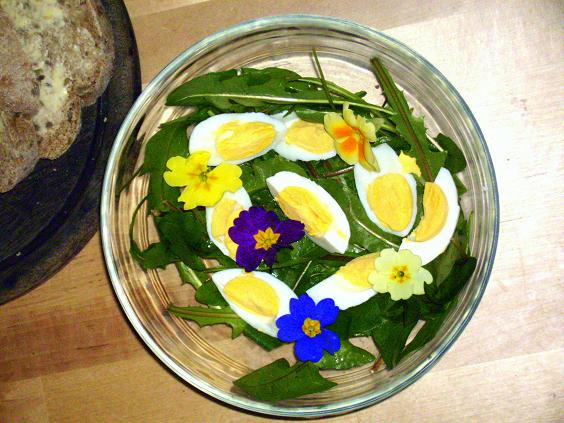 It's the middle of January. The excitement of Christmas and New Year has worn off, and there are still a couple of months of cold wintry weather to go. I'm sick of the rain. I'm sick of the gales. I'm sick of root vegetables and cabbage. So I curl up in an armchair with a selection of seed catalogues and choose what kinds of salad I'll be growing in 2008.
Salad leaves are a brilliant choice for a vegetable gardener. Have you seen the prices of those bags of mixed leaves in the supermarkets? You can save money by buying a lettuce from the greengrocer, but sometimes they're a bit limp, and anyway mixed salad is tastier than a heap of shredded cos. If you grow your own you get the best of all worlds - spanking fresh crisp salad, a selection of leaves, no food miles at all, and all for the cost of a packet of seeds.
I like the packets of mixed salad leaves you can get, so you get a variety of different flavours and colours. The important thing to remember is successional sowing. In other words, don't sow all the seeds in the packet at once, otherwise you'll suddenly have dozens of lettuces on your hands that you won't be able to eat before they go to seed, and then you'll have no lettuces at all. I mark out a line with sticks and string, then I sow a few seeds (you can't easily count them - salad seeds are typically very small). A week later I sow a few more, and thin out the plants that have started coming up. I do this once a week through the spring and summer for a continuous supply of salad leaves. If more lettuces come up than I can eat, I cut them anyway and give them to neighbours and friends. It's probably nonsense but I can't help feeling that when you allow plants to bolt it somehow encourages other plants nearby to bolt as well, and before you know it things are going to seed all over the garden. Have you noticed that?
Some salad varieties are good for "cut and come again". Instead of growing the plants until they form mature heads, you cut off the young leaves with scissors, and a new growth of leaves appears later from the base. You can get several crops from a single seed this way, you can sow them closer because they don't grow so big, and you don't need to worry about them bolting. Suitable varieties include chard, corn salad, endive, kale, land cress, sorrel and tatsoi.
Don't forget more unusual salad ingredients. Young dandelion leaves are delicious in a salad - they taste peppery, rather like rocket or watercress. When you pinch out the tops of your pea plants don't compost the tops. They're divine in a salad bowl, and in fact I saw bags of them in Tesco last year, but the price made me laugh. I grow spinach for cooking, but I also love to use the young leaves in a salad, especially a strong-flavoured salad with thinly-sliced red onion rings and perhaps the seeds from half a pomegranate, dressed with black pepper and a splash of balsamic vinegar. Nasturtium leaves are good in a salad if you can wash all the blackfly off them, and the flowers are also edible. The leaves and flowers together make a really attractive salad. In fact a lot of young leaves can be used as salad greens, so whenever you're thinning out seedlings such as turnips, beetroot, radishes etc., why not have a little munch on some of the leaves and decide if you'd like to take the thinnings home for salad, rather than just composting them?
Thursday, January 10, 2008
Review: Food Not Lawns
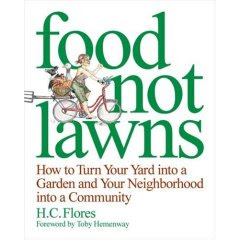 They say you shouldn't judge a book by its cover. You shouldn't judge it by its title, either. I spent the first half of Heather Flores' Food Not Lawns feeling rather frustrated at the lack of direct advice about turning your lawn over to food production. Instead the book is a rambling diatribe expounding the author's position on a variety of environmental, social, and spiritual topics. By the time I got to the end of it, I felt it had some interesting ideas in it but it really needed a different title. If you want to turn your lawn into a veg plot this isn't the book for you. At least, it's not the only book you'll need.
The mismatch between the title and the content of the book is continued in the chapters. Chapter one is titled "Free Your Lawn". Sounds like it's about freeing your lawn, perhaps to grow food, doesn't it? Instead it mainly contains the author's biography. The titles of chapters and sections don't necessarily give you much clue what the section is about. The chapter titled "Ecological Design" is mainly about a sort of mandala she calls a "spiral design wheel" which has "look deep" at the centre, and opens out through layers with names such as "let autonomy reign" and ends up with "COSMOS - SOCIETY - WILDERNESS - SELF - CHAOS" etc. It was all too hippy-dippy even for me, and I have a high hippy-dippy tolerance cut-off. I laughed out loud when she described her admiration for John Jeavons' "How to Grow More Vegetables", another book I couldn't get away with because it was too rambling, vague and hippy-dippy.
I'm glad I read Food Not Lawns because it does contain some interesting ideas. My favourite bits of the book were nothing to do with veg growing, but were about getting involved in your local community through activities such as seed swaps. The section about remembering to include children was also great. I wish I'd read the book with a highlighter pen so I could have marked the bits I liked. If I ever want to find them again, it'd be like wading through treacle.
If you like mandalas, yoga and community theatre this might be the book for you. If you think digging a deep hole, standing in it, then getting a friend to bury your feet and legs and then water you whilst you;
...raise your arms to the sky and imagine your leaves and branches unfolding, expanding towards the heavens. Close your eyes and imagine blooming, setting seeds, wilting, and returning to the earth.
will help you become more attuned to the mystic cosmic wossname, then you might like this book. I didn't like it so much. I prefer The Vegetable and Herb Expert by Dr D.G.Hessayon
Subscribe to:
Posts (Atom)