Showing posts with label permaculture. Show all posts

Wednesday, October 22, 2008

Sad News

charcoal sketch of chickensOn Saturday I spent some time in the garden sketching things in charcoal, including the chickens. They all seemed fine. On Sunday I got dressed up in old jeans with holes in them, an old faded t-shirt, marigold gloves, headscarf and wellys (with a fetching cow-skin print) and went to clean out the chicken coop and run. It's a mucky job, and long overdue this time, but satisfying. I spotted one of the new Rhode Island Reds lying in the run, apparently dead. She moved a little when I went to investigate, but shortly afterwards she did expire.

I don't know what was wrong with her. She had seemed fine the day before. All the other chickens are healthy and well except for a mite infestation, which is why I went out to clean the housing and treat it. Anyway mites on a chicken are like fleas on a dog - they're annoying but not lethal. There was no sign that anything had got into the run or harmed her. She was only 18 months old.

We have two older chickens, both hybrid layers, which we got at the same time and have always got along well with each other. Then we got two Rhodies in January, and they were pals with each other but the older girls bullied them a bit. Well whilst I was cleaning the hen house, the surviving Rhodie went over to her dead sister, lowered her head to her and made soft clucking noises. I don't think we should anthropomorphise animals (anyway, they don't like it), but it was impossible not to interpret it as saying something like "Elsie? Are you OK? Elsie, what's the matter? Get up!" And she pecked at the dead bird a couple of times as if prodding her to move.

I buried her at the back of a flower bed. I might pop a few spring bulbs on top later.

Friday, May 02, 2008

Gardening Leave

muddy fingers"Gardening leave" is usually a euphemism for someone being suspended from their job. But Ed actually took a day of his precious holiday time to work on the allotment.

We dropped the kids at school at 9am, and then spent all day at the plot. At 3pm I collected the kids from school whilst Ed remained on the allotment for another hour. Then we swapped shifts and I stayed on digging for another couple of hours. All told I think we did about 12 man-hours today.

We weeded about half the area we had last year (we have a new bit - a scary jungle to be tackled later). We dug and manured the bare areas and planted leeks, carrots, curled borecole, calabrese, purple sprouting broccoli, cauliflowers, and French marigolds. Yes I know it's supposed to be tagetes for companion planting, but I couldn't find any. And the main reason I wanted them is that I resolved to have more flowers on the plot, just for pleasure, so French marigolds are as good as anything.

We weeded amongst the overwintered shallots and broad beans, so now we can see how well they're coming along. We weeded and tidied the herb bed and planted some bronze fennel and rosemary for height at the back.

We strimmed the green manure I planted in late autumn and Ed dug it it. Ed says he does not like green manure, simply because he does not like the "digging it in" part. If anyone wants to tell us that part is not necessary, we'd be pleased to hear from you. In any case, there is an enormous pile of the brown sort of manure and we made good use of it, so the green type seems unnecessary.

Fortunately the weather remained glorious all day. The forecast says heavy rain over the weekend, although Monday (a bank holiday here in the UK, and the reason for Ed's non-euphemistic gardening leave) is forecast to be fine. We'll see. When it's fair, we'll garden, and when it's pouring, we'll do something else. When you put it like that, the forecast is neither here nor there.

Monday, March 17, 2008

Getting Ready for Planting

view of allotmentsWe haven't been down to the allotment so far in 2008. Either the weather has been dreadful (you can't really garden in a gale) or we've been very busy doing other things, or we've been ill. So last weekend we took the opportunity to get stuck in.

I planted some raspberry canes and weeded a bed full of some kind of alliums - they're either onions or shallots, or possibly funny-looking garlic. I simply can't remember what I planted there, and if I put a label on then it must have blown away. Anyway, whatever they are they're looking well. I do remember where I planted the garlic which came from the garlic fairy. That's looking great, too, and I'll get round to weeding it soon.

Ed dug some ground elder out of a bed ready for us to plant something there. There's a lot of things need planting soon and we haven't yet decided what is going to go there. The broad beans I planted in October have grown slowly all winter and are now ready to leap into action as the days start getting longer. I hope we'll get a crop off those fairly soon, although I've planted far too many and always intended that some of them would just be dug back into the ground as green manure.

I also planted as green manure a proprietory mixture from the garden centre. It contains rye and tares and other things I can't remember or identify. It has come up nicely and has smothered out any weeds in the patch where I sowed it. It now needs mowing and digging in, then leaving to rot for a little while before I plant out the nicely enriched bed. It's basically the same thing as the fallow part of old crop rotation methods, putting nutrition back into the soil. So I'll plant something hungry there that will appreciate the extra nutrients.

I could go on - there are a couple of clumps of daffodils that always make me smile when I visit the allotment in Spring. Next time I go I'll probably cut a few unopened ones to bring back to the house. My rhubarb is starting to come up, but the variety on my plot is a late starter and I'm always jealous of my neighbours with early rubarb varieties. Maybe I can barter some early rhubarb for eggs or something. I've still got brussels sprouts growing on the plot, and late-season spuds in storage, although I'm pretty sick of them by now. I'm clamming for fresh home-grown salad, radishes, tomatoes, peas, mmm-mmm. I want it to be summer already but it's not even the equinox yet.

Thursday, January 10, 2008

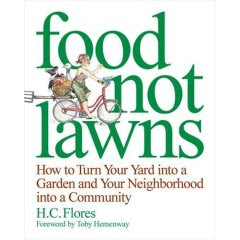
Review: Food Not Lawns

Food Not LawnsThey say you shouldn't judge a book by its cover. You shouldn't judge it by its title, either. I spent the first half of Heather Flores' Food Not Lawns feeling rather frustrated at the lack of direct advice about turning your lawn over to food production. Instead the book is a rambling diatribe expounding the author's position on a variety of environmental, social, and spiritual topics. By the time I got to the end of it, I felt it had some interesting ideas in it but it really needed a different title. If you want to turn your lawn into a veg plot this isn't the book for you. At least, it's not the only book you'll need.

The mismatch between the title and the content of the book is continued in the chapters. Chapter one is titled "Free Your Lawn". Sounds like it's about freeing your lawn, perhaps to grow food, doesn't it? Instead it mainly contains the author's biography. The titles of chapters and sections don't necessarily give you much clue what the section is about. The chapter titled "Ecological Design" is mainly about a sort of mandala she calls a "spiral design wheel" which has "look deep" at the centre, and opens out through layers with names such as "let autonomy reign" and ends up with "COSMOS - SOCIETY - WILDERNESS - SELF - CHAOS" etc. It was all too hippy-dippy even for me, and I have a high hippy-dippy tolerance cut-off. I laughed out loud when she described her admiration for John Jeavons' "How to Grow More Vegetables", another book I couldn't get away with because it was too rambling, vague and hippy-dippy.

I'm glad I read Food Not Lawns because it does contain some interesting ideas. My favourite bits of the book were nothing to do with veg growing, but were about getting involved in your local community through activities such as seed swaps. The section about remembering to include children was also great. I wish I'd read the book with a highlighter pen so I could have marked the bits I liked. If I ever want to find them again, it'd be like wading through treacle.

If you like mandalas, yoga and community theatre this might be the book for you. If you think digging a deep hole, standing in it, then getting a friend to bury your feet and legs and then water you whilst you;
...raise your arms to the sky and imagine your leaves and branches unfolding, expanding towards the heavens. Close your eyes and imagine blooming, setting seeds, wilting, and returning to the earth.

will help you become more attuned to the mystic cosmic wossname, then you might like this book. I didn't like it so much. I prefer The Vegetable and Herb Expert by Dr D.G.Hessayon

Tuesday, November 06, 2007

Weed of the Week - Comfrey

I think my favourite thing about comfrey is the name. It's one of those words that is pleasurable to say. Say it out loud - comfrey. Com - frey. Ooh, lovely.

It's also a very useful plant. Its deep roots bring up nutrients from the subsoil, especially potassium. Think of it as non-smelly manure you can grow. You can add the leaves to your compost where they will speed up the decomposition in much the same way as fresh farmyard manure. You can stick bundles of leaves in a bucket and cover with water where they will rot down to a really foul smelling "tea" - you then dilute it to the colour of black tea and pour it on hungry plants as an organic plant food (you can also do this with fresh manure - see what I mean?) Or you can just stick the comfrey leaves in a bucket with no water where they will decompose spontaneously to thick black slime, which is just an even more concentrated form of the same plant food. It absolutely stinks to high heaven, so the manure analogy continues. If you dig a trench you can drop comfrey leaves all along the bottom, as you would well-rotted manure, and then plant crops such as potatoes in there. Or if you are planting out a pot-grown plant or seedling you can shove a comfrey leaf or two in the bottom of the hole. And you can lay a few leaves around your seedlings where they will act as a mulch to prevent water loss and enrich the soil - just like well-rotted manure. This is especially helpful for tomatoes which guzzle the potassium. Don't feel afraid to cut as much as you need - even as far as cutting back the whole plant. It will regrow with amazing rapidity, and seems to come back stronger every time.

It's clearly invaluable to an organic gardener, but it is also prized for its healing powers in humans. One old name for it is "knitbone", and scientific research has confirmed that it is beneficial in bone disorders. However it must not be taken internally as it can have very bad effects on your liver. If you come across any old herbal remedies that advise you to drink it as a tea for example, you should know that this is now considered a very bad idea. But preparations of comfrey for external use, such as oils, ointments or the fresh leaves, are used for skin conditions such as acne and rashes, for bruises, and for broken bones and sprains.

So why is this "weed of the week"? Why not "Very useful and beneficial plant of the week"? Well, if it's growing somewhere you don't want it to - bad luck. It's very hard to get rid of. Its deep roots which give it such useful properties also mean you'll have to dig an enormous hole to get it out. The roots are very brittle, so if you don't dig a deep enough hole, you'll snap the tap root and leave a bit behind. And sure as God made little apples, this will regrow. Don't think you can just cut it back either. As I said earlier, the more you cut it, even cutting off every leaf, the stronger it seems to get. It doesn't spread terribly fast, although if you let it set its pretty purple flowers, seedlings will appear. Deal with them quickly before they establish.

The best approach seems to be this one: if you have comfrey growing in your garden or allotment, declare that place to be your "comfrey patch". Erect a little sign if it makes you feel better. Fence it off if you like. Consider yourself lucky to have a healthy comfrey patch, and don't neglect to make much use of it. Because you probably couldn't get rid of it even if you wanted to.

Saturday, October 20, 2007

Roots, Pots, Legs and Bras

We've had a few hard frosts at night and the allotment is transformed. Squash plants deflate like a popped balloon. Runner beans turn black and limp. It's time to tidy up.

Spent plants can be put on the compost heap or dug directly into the ground. Beans in particular do a lot of good because they capture nitrogen from the atmosphere and "fix" it in the ground. You can pay a lot of money in a garden centre for nitrogen-rich fertiliser. Or you can just plant some beans and wait a season.

I'm fuzzy on the science, but I know these curious nodules on the beans' roots are involved (see the photo). The bottom line is - plant beans, dig them into the ground when they're finished, and put brassicas in the same earth next time. Brassicas love the nitrogen.

If you can't remember the order of the 4-crop rotation, try this mnemonic "Roots [point to ground, where roots grow], pots [point to your boots, like plant pots for humans], legs [point to your legs], bras [you can invent your own gesture for this one]". That's the order - roots, pots, legs and bras. Root veg first (like carrots, parsnips etc.), then pots (potatoes), next legs (legumes i.e. beans and peas) and finally bras (brassicas, that's cabbage, sprouts etc). Then you're back to roots again.

Sunday, July 22, 2007

What is Permaculture Anyway?

I've added a few new blogs to my blogroll, and invited them to link back to me. I'm always happy to exchange links with like-minded bloggers. Just email me if you'd like to swap links. One of the new links is called Permaculture in Brittany. The blog owners Stuart and Gabrielle emailed me to suggest a new "Permaculture" section in my links.

What is permaculture anyway? Well, as I understand it, it's the philosophy of working with nature rather than against it. So instead of battling weeds, fighting pests, combating your local conditions of soil, light, water, climate etc. you instead see yourself, the gardener, as part of a whole ecosystem.

I've written about the principle of return - that you take nothing away from the land unless you can return something of equal or greater value. So our weeds are composted or turned into weed tea. That's very permaculture. And our edible vandal-proof hedge which serves multiple functions at once, is also very permaculture. Systems like companion planting, intensive spacing, and encouraging biodiversity are all very permaculture.

For a while I couldn't get my head around permaculture. It just sounded like plain common sense. I kept asking "But what is it?" Until it dawned on me - that's all it is. Common sense. It's just that common sense isn't all that common any more.

So, Stuart and Gabrielle , I don't think I'll add a "Permaculture" section, simply because I wouldn't know who to put in there. I think almost all my links could comfortably fit in a section labelled "Permaculture", but it wouldn't be very helpful just to have one big section with everybody in it. So I've put you in "Self Sufficiency Blogs" with Stonehead, Irish Sally Garden, Wombat and all the others. I think you'll agree you have a lot in common with them all, whether or not they'd describe themselves as permaculturists.

Thursday, July 19, 2007

Dead Zone in Gulf of Mexico Set to Break Records

Agricultural fertilisers which run off fields and flow into rivers form dead zones when they are washed out to sea. The fertilisers which feed farmers' crops also feed the microscopic plant life of the sea - algae. Huge sheets of algae form which starve the surrounding waters of oxygen. Nothing can live below - no fish, no sharks, no whales, coral, nothing.

The Gulf of Mexico dead zone is expected to be a record-breaker this year, exceeding last summer's 6,662 sq miles (17,255 sq km). That's pretty close to the area of Wales (for some reason, these things almost always are). Imagine that - a region of sea which should be teeming with fish and other life, covered in a blanket of green algae but otherwise dead.

So next time you're wondering whether it's worth paying the extra for the organic fruit and vegetables, ask yourself instead whether the cheaper cost of conventional fruit and vegetables is worth a 6,662sq mile dead zone in the Gulf of Mexico.

Elephant Escape

I was watching a news story on TV about two elephants who escaped from a Canadian circus. They did no damage apart from leaving some dung on someone's lawn. My 7-year old daughter Eleanor commented "I don't what those people are complaining about. At least they got some great manure".

That's my girl!

Tuesday, July 10, 2007

10 Reasons To Eat Organic

1. It's better for you.

2. It's better for your children. Because of their smaller size, children are more affected by pesticides in their food than adults, but feeding them organic food has been proved to significantly reduce their intake of pesticides.

3. It's better for the farmers and their families if they don't have to use pesticides and other toxic chemicals. This is especially true in countries which have less strict health and safety legislation.

4. It's better for the farm animals. Joyce d'Silva of Compassion in World Farming said "Organic farming has the potential to offer the very highest standards of animal welfare."

5. It's better for wild animals. In one study, organic farms were found to contain 85% more plant species, 33% more bats, 17% more spiders and 5% more birds than conventional farms.

6. It's better for the planet because it doesn't lead to soil erosion. Conventional farming is responsible for unsustainable soil loss, but organic farming actually builds the soil.

7. It doesn't lead to waterway pollution.

8. It doesn't depend on oil-based agrochemicals.

9. It uses less energy because it relies on people rather than machinery. David Milliband said “in many, but not all cases, [organic food] produces fewer greenhouse gases”.

10. It tastes better, and don't believe anyone who tells you they don't. Many years ago my sister Stephanie was helping me chop some carrots for our lunch and she ate a slice of carrot. Immediately she started exclaiming "Oh, oh, these carrots are wonderful! Why do they taste so good?" She hadn't known they were organic carrots.

Convinced? Why not sign up for an organic veg box to be delivered to your door?

Remember there are only two more days to enter our Skooperbox competition. There have only been seven correct entries so far, so your chances are excellent of winning a package of Skooperboxes, the recycled biodegradable dog poop scooper. All correct entries will be entered into a draw and winners will be announced on Wednesday.

Sunday, June 24, 2007

How To: Make a Lacewing Shelter

Do you remember when garden centres just used to sell gardening stuff? Now they sell everything from hand cream to cream teas. They seem to do a roaring trade in wildlife shelters, like mason bee boxes, ladybird houses, and bug blocks. I'm really glad that more people are taking an interest in our native wildlife, and trying to help them along. But at the risk of upsetting Wiggly Wigglers again (just teasing) you can make most of these things yourself out of recycled materials.

Here's how to make a lacewing shelter (why would you want to make a lacewing shelter? because lacewings are beautiful, and also because their larvae gobble up aphids like there's no tomorrow).

You will need some corrugated cardboard, an empty fizzy drinks bottle, scissors or a craft knife and some twine.

First of all rinse the fizzy drinks bottle and cut the bottom off. Leave the lid on, otherwise rain will soak the cardboard.

Then cut a strip of corrugated cardboard slightly shorter than the length of your bottle. It's important to cut it across the corrugations, not along them. This is the hardest direction to cut in. So if you're finding it very easy to cut, you're probably cutting it the wrong way.

Score a few lines close together at one end of your strip to make it easier to roll up. Then roll the strip really tightly.

Jam it into the fizzy drinks bottle. It needs to be a really tight fit. If it isn't, add more strips of card until you have a nice tight fit.

Tie some twine around the neck and hang it up. Lacewings will shelter inside. You can change the cardboard once a year if it gets ratty.

See? Easy. But if you don't want to make one you can buy ready-made bug habitats from Wiggly Wigglers, who are very nice people.

Saturday, June 23, 2007

Famous Allotmenteers

Did you know Albert Einstein had an allotment in the Kolonie Bocksfelde in Berlin-Spandau in the early 1920s? It seems he wasn't a very assiduous allotmenteer, because he was sent a note by the local authority taking him to task about the state of his plot:

You are presently leasing allotment 2 at the Burgunderweg in Boxfelde. Said allotment has not been managed since a long time, weeds have spread all over the whole parcel and have soared. The fence is not in order, and the whole allotment makes an unesthetic impression. We have to assume that you are no longer interested in leasing the parcel, and we will give it away to someone else, unless you object prior to the 25th of this month, and the allotment is put in order until that date. Please take care of the removal of this nuisance, and give us further notice.

So that's two things I feel good about - I'm a better allotmenteer than Einstein and I'm probably a better physicist than Monty Don.

Sunday, June 03, 2007

Good King Henry

You may be wondering why it says "Now picking - Good King Henry" in the right-hand sidebar. Good King Henry is a common weed that grows prolifically on our allotment. It's a friendly type of weed, though. Annual and shallow-rooted, it's easy to get rid of if you want to (unlike the couch grass, ground elder, bindweed, docks and dandelions that plague us). It's also tasty when picked young and used in salads or lightly cooked like spinach.

Thursday, May 31, 2007

What's Decomposing?

(In homage to http://www.compostbin.blogspot.com/)

We get our hair cut by a friend who comes to our house every few weeks. The kids come into the kitchen one at a time, then when they're shorn they can go back to watching TV or whatever they were doing before. It beats trying to keep them under control at a hairdresser's shop.

We end up with a big pile of hair on the floor, and this is another bonus of having our hair cut at home. The cuttings go on the compost heap where they decompose just like all the other organic material we put there.

Human hair is said to deter pests such as rabbits, moles and deer - shy creatures who avoid the scent of humans. Put handfuls of hair in net bags and tie them to trees and fences around the garden. If you need more hair than you can personally provide, you may be able to scrounge some from your local barber shop. I can't vouch for this tip personally as I don't suffer from mammalian garden pests, and I doubt it works on sassy critters like mice who come right into human houses.

Saturday, May 26, 2007

Blue Tit Chicks

There's a nesting box in our back garden and every year it attracts blue tits. They've got a brood of chicks at the moment and it's fun to watch the parents flying backwards and forwards with caterpillars for the noisy chicks. I managed to get a picture of a little gaping mouth at the opening of the box.

Thursday, May 24, 2007

Weed Tea

The weeds are growing on the allotment faster than I can deal with them. But every cloud has a silver lining, and I've used some of this fabulous green manure to make a huge drum of weed tea. No, it's not an accompaniment to cannabis cookies, it's home-made plant food. Much cheaper than buying tomato food from the shops, and another example of the law of return - never take anything away from the land unless you can put something of equal value back.

Weed tea is easy to make. Fill a container (we used a huge plastic drum that was left on the allotment when we took it over) with weeds - leaves, roots and all. I used a bunch of big dock roots and couch grass roots, as well as a trug full of leafy weeds such as cleavers, good king henry, bindweed and dandelions. Then I added as much comfrey as I could gather. Comfrey is fantastic stuff, and I always make sure I leave a clump somewhere on purpose (that's what I tell people anyway. The truth is it's a bugger to eradicate even if you wanted to). It has a deep root system and draws up nutrients from deep in the soil. As a result it is rich in the NPK (nitrogen, phosphorous, potassium) nutrients that plants need. It is a great addition to your compost heap, you can lay the leaves around seedlings as a mulch and feed combined, or you can use it to make cheap top-quality plant food like this. I'll also bring some chicken manure from home to add to the tea next time I go to the allotment. You could add nettles, manure (sheep, cow or horse - not cat, dog or human). You can put in grass clippings, seaweed, even perennial weeds like horsetails, bindweed, even japanese knotweed! Anything you've got a lot of, heave it all in, and cover it with water.

Now you need to cover it tightly because once it begins to ferment it will smell like the devil belched. Leave it a few weeks, then put on gloves and a gas mask (I pull my jersey over my nose and mouth) and ladle some into a watering can. Dilute it with clean water until it's about the colour of tea, and feed it to your plants. Tomatoes love it, so do courgettes and pumpkins, cucumbers, all those hungry crops that take a lot out of the soil. I'm told it's also good for flowers, and I'm prepared to believe it. The stuff is liquid gold and every gardener should have some on the go at all times. What's your excuse? Haven't you got enough weeds?

When you've used it all up, tip the foul black gunge that's left over on the compost heap and start another batch. See, even weeds have their uses!

Thursday, May 17, 2007

10 Reasons Why Everyone Should Keep Chickens

  1. You get eggs

  2. They're no trouble. You top up their food and water occasionally, clean out their house occasionally, collect the eggs and that's about it

  3. Honestly, they're no trouble at all. A lot less effort than having a dog or even a cat. About the same as having a guinea pig or a rabbit, I'd say

  4. The eggs are cheaper than buying them because the food costs, well, chickenfeed

  5. The eggs are much, much nicer than shop-bought eggs, even free-range organic ones

  6. When they stop laying you can eat them if you like, as long as you haven't got sentimental about them

  7. They eat garden pests such as slugs, snails, leatherjackets etc.

  8. You can put their bedding plus the manure on the compost heap. It's excellent activator and will improve your garden or veg plot no end

  9. Even free-range eggs are often produced in conditions you might not expect. The hens must have theoretical access to an outdoor run but in practice they might never get there. They're less crowded than battery hens it's true, but still their living conditions won't be a patch on your own pampered hens, and that's why your own hens' eggs taste better (see point 5)

  10. You really feel you're living the good life when you have chickens in your back garden

Thursday, April 26, 2007

Top Ten Reasons Why Everybody Should Grow Food

  1. It's good exercise - you may not feel happy at the idea of taking more exercise but research overwhelmingly shows that it boosts your mood and makes you happier.

  2. It gets you out in the sunshine - this also may make you happier if you are one of the approximately 1 in 10 who suffers from SAD.

  3. You get a sense of satisfaction from seeing a result of your effort.

  4. You will feel more motivated to eat fruit and vegetables when you have grown them yourself.

  5. Food will be fresher and taste better when you have grown it yourself.

  6. You will cut your food miles down to food yards, saving all the aviation fuel used to transport produce and reducing the damage to the planet.

  7. Many aspects of gardening seem miraculous when you are actually involved in them - you may know intellectually that seeds grow into plants, and waste decomposes into compost, but when you actually do it, it seems wondrous.

  8. It gives you something to look forward to. In the winter you look forward to spring when you can plant things. in spring you look forward to summer when they will grow. In summer you look forward to autumn and the harvest. In autumn you look forward to winter, a rest from your labours and a realistic prospect of getting the better of the damn weeds.

  9. You gain a much better understanding of what food is, where it comes from and what goes into it, and just how precious it is.

  10. You also gain insight into all the many people, past and present, whose lives have revolved around producing food. So many of the stories in the Bible, so many nursery rhymes and children's stories, as well as adult novels and poetry and many other cultural works, describe the process of farming and the consequences of failure. The news often carries stories of drought or floods or vanishing bees causing crop failures. We are cut off from understanding them fully by our modern way of life, but simply by growing a few vegetables we can understand rather better.

Monday, April 16, 2007

Soap Nuts

I bought some soap nuts from Lakeland just to try them out. They're dried seed pods that make a soapy substance when they get wet. If you squish the wet pods in your fingers and bubbles come out. You put a few nuts in a little drawstring bag in with your laundry instead of using detergent, or you can put a few of them in the cutlery holder of your dishwasher. You can also reuse the same nuts a few times, and when they are exhausted you can put them on the compost heap.

In the washing machine they seem to get clothes clean, but then again I learned that clothes get clean even when you put nothing in the machine - no detergent, no "eco wash balls", nada. Still clean. So that's what we usually do nowadays.

I also tried them in my dishwasher. Now I know that stuff in the dishwasher doesn't get clean if you forget the dishwasher powder. I've tried it and the dishes come out rather manky. I've been looking for a more natural alternative to dishwasher tablets/powder for some time and these seem to fit the bill. The dishes came out clean, I was pleased with the result.

On the other hand the soap nuts come all the way from India. It seems a bit daft to be really fussy about eating only local food and then use nuts from India to wash the dishes afterwards. I also can't find any information about the condition these nuts are produced in. Are Indian farmers grubbing up the crops that feed their own families to plant soap nut trees as a cash crop? If so, are they being paid fair prices for the nuts? Or are people raiding natural forests to harvest these nuts now that westerners are suddenly buying them? Just what does commercial soap nut production involve?

When this packet runs out, I don't think I'll be buying any more. Although I'd be interested in them as an alternative to dishwasher tablets, there are just too many questions about their environmental impact for me to feel happy about using them.

Sunday, April 15, 2007

Lettuces

There's still a danger of frost in this area, but you can sow lettuces as long as they're protected. A cold frame is great, but if you plant small varieties like Little Gem you can use a two-litre drinks bottle with the bottom cut off as an individual cloche. Use a garden cane stuck well into the ground to prevent it from blowing over in the wind, and don't forget to water it because the rain can't get in.