 I thought I was so clever, using shredded waste paper as chicken bedding. But the problem is that shredded paper, when combined with chicken poo and left to dry, becomes a kind of combination of papier mache and adobe. It's almost completely impossible to remove from any surface it adheres to, including hens' ankles. On the other hand, I may have inadvertently invented an exciting new environmentally-friendly building material.
Showing posts with label chickens. Show all posts
Showing posts with label chickens. Show all posts
Wednesday, October 29, 2008
Hen House Cleaning
I thought I was so clever, using shredded waste paper as chicken bedding. But the problem is that shredded paper, when combined with chicken poo and left to dry, becomes a kind of combination of papier mache and adobe. It's almost completely impossible to remove from any surface it adheres to, including hens' ankles. On the other hand, I may have inadvertently invented an exciting new environmentally-friendly building material.


Wednesday, October 22, 2008
Sad News
 On Saturday I spent some time in the garden sketching things in charcoal, including the chickens. They all seemed fine. On Sunday I got dressed up in old jeans with holes in them, an old faded t-shirt, marigold gloves, headscarf and wellys (with a fetching cow-skin print) and went to clean out the chicken coop and run. It's a mucky job, and long overdue this time, but satisfying. I spotted one of the new Rhode Island Reds lying in the run, apparently dead. She moved a little when I went to investigate, but shortly afterwards she did expire.
I don't know what was wrong with her. She had seemed fine the day before. All the other chickens are healthy and well except for a mite infestation, which is why I went out to clean the housing and treat it. Anyway mites on a chicken are like fleas on a dog - they're annoying but not lethal. There was no sign that anything had got into the run or harmed her. She was only 18 months old.
We have two older chickens, both hybrid layers, which we got at the same time and have always got along well with each other. Then we got two Rhodies in January, and they were pals with each other but the older girls bullied them a bit. Well whilst I was cleaning the hen house, the surviving Rhodie went over to her dead sister, lowered her head to her and made soft clucking noises. I don't think we should anthropomorphise animals (anyway, they don't like it), but it was impossible not to interpret it as saying something like "Elsie? Are you OK? Elsie, what's the matter? Get up!" And she pecked at the dead bird a couple of times as if prodding her to move.
I buried her at the back of a flower bed. I might pop a few spring bulbs on top later.
Friday, May 30, 2008
Four Egg Day
 When we had only two hens we got two eggs each day. So when we got two more hens we naively assumed we'd get four eggs each day, after a settling-in period.
But our two older girls are hybrid layers. They're bred to produce an egg a day. The new girls are Rhode Island Reds, and there are some differences we didn't expect. Rhodies are utility birds, bred for meat and eggs. They're not as good at producing eggs as hens bred to be layers, and they're not as good at producing meat as birds bred for that purpose. But they're a practical compromise for homesteaders and smallholders.
Pure bred birds also go broody more readily than hybrids, as we've already found. So a four-egg day is a special occasion rather than a daily event.
Saturday, May 10, 2008
Broody Hen
 One of my young Rhode Island Red hens is broody. She is sitting on all the eggs and cannot be persuaded to move. She wants to hatch the eggs and have some chicks. She wants to be a mum.
The problem is, she isn't laying any eggs herself. She may not be eating or drinking either. Broody hens can die of hunger or thirst if they are just ignored. We've got to do something about it.
There are various techniques to stop her being broody. They all involve preventing her from settling down and getting comfy. For example, we could construct a broody coop - a suspended wire cage where she would be kept separate from the other hens until she gives up the idea of egg-sitting. The cage would be cosy and she would have water and food, so it's not as cruel as it sounds. Apparently it's usually successful within a few days. I've also heard of dunking the hen's undercarriage in cold water a couple of times a day. Now that does sound a bit cruel but I'm told it works. And I've seen an ingenious suggestion to replace the eggs with a frozen freezer block. You have to replace the freezer block a couple of times a day to keep it cold. I bet that would work a treat - the hen would have to be really determined to sit on that.
But there's another possibility - we could get some fertilised eggs and let her hatch them. Then in about three weeks we'd have chicks. It sounds like a lot of fun, but Ed very sensibly pointed out that we already have more eggs than we need, so we really don't need any more birds. Boo - what a spoilsport.
Sunday, March 23, 2008
Practical Jokes for Chickens
 I sometimes check my blog stats to see which search terms bring visitors to Bean Sprouts. "How to make Greek Yogurt" is popular, as is "Can I eat bean sprouts when pregnant?".
But one I saw today made me laugh: "practical jokes for chickens".
Monday, February 25, 2008
New Chickens Settling In
 BEFORE
AFTER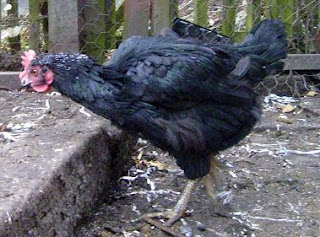
The black chicken I was worried about is looking much better. Her feathers are starting to regrow. So that means it was either:
a) mites, and the mite treatment worked, or
b) stress, but now she's not so stressed any more, or
c) an oddly-timed moult, and now she's done moulting, or
d) pecking, but whoever was pecking her has stopped, or
e) something else.
So not very satisfactory from a deductive-reasoning point of view, but a satisfactory outcome for the chicken.
Their behaviour is returning to normal. There is definitely a pecking order, with the old girls ruling the roost and the new girls as underdogs. But they are mixing more, and aren't huddling at opposite ends of the run anymore.
Egg production is up, too. We're now getting two eggs a day, which is the same as before we introduced the new girls (but they're eating twice as much food and needing twice as much attention, mucking out, topping up water and so on). So that's not entirely satisfactory either. I'm still looking forward to collecting four eggs in a day. I will tell you if that ever happens.
Friday, February 08, 2008
What's Up With this Chicken?
 What's up with this chicken? Here's what she normally looks like. But since we introduced two new chickens a couple of weeks ago she has been losing feathers. I can think of several reasons why chickens might lose feathers:
1. Mites. But if she has mites surely the others would have them too. Whatever it is, she's the only one affected.
2. Pecking. Unlikely, because she's the top chicken. I've never seen her and our other old girl peck each other. Both the old girls chase the two new girls, but the new girls have all their feathers.
3. Moult. It's the wrong time of year. Then again, chickens can be deliberately contrary. It could be moult.
4. Stress. I reckon this is the most likely cause. It started when we introduced new chickens. None of them are laying terribly well, so I know they are all stressed. There are lots of black feathers below the spot where she roosts. I think she's pulling them out herself at nights.
I might treat them for mites, just in case that's it. But I think it's more probably the stress of adding new chickens that is making her pull out her own feathers. I plan to do nothing and just observe them for a bit longer. With any luck she'll get used to the new status quo and return to her old self.
Saturday, February 02, 2008
New Chickens Settling In
 Now that I've doubled my flock of chickens, I need to top up the water and the food twice as often, and muck out the hen house and the run more often. However I don't need to collect the eggs more often, as they're still not laying properly. Since Monday I've had 4 eggs, and 3 of those were from the new girls (I can tell them apart because the new girls' eggs are smaller and sort of elongated).
I knew that introducing new birds would unsettle all the chickens, but I'm sure they'll return to laying an egg a day soon. I'm just surprised that my old ladies are more unsettled by it than the new girls. They're still all avoiding each other. I'll let you know the first time I get four eggs in a day.
Monday, January 28, 2008
New Chickens
 My neighbour, Maria, came around yesterday to offer us two chickens. She has seven, and two of them don't get on with the other five, who bully them. She thought they might get on better with my two, since the numbers are equal. It's worth a shot.
She brought them round at dusk and we shoved them in the coop. The four sleepy chickens clucked softly at each other a bit, but soon settled down. By the time they were fully alert (well, as alert as chickens get) they had already been together 12 hours and so were somewhat familiar and less inclined to fight. They're a bit "This is our corner of the run and that can be your corner" but they're not actually battling each other. I think they'll be fine.
Maria says the new chickens are Rhode Island Reds. I'm no breed expert, but that looks about right to me. They hatched last April and so haven't been laying very long. A hen only has so many eggs in her before she stops laying, so it's good to get them young. Ours are a couple of years old now, and sooner or later they'll stop laying, although they're still very good layers and have laid all through this winter which is great.
I'm not expecting any eggs at all for a few days until the four of them settle in together, but then we should have 4 eggs a day, which is more than we eat. I plan to sell the surplus, to pay for the chicken feed. Then the eggs we eat will be free, in effect. Free eggs, free-range organic eggs as well. You can't complain about that.
Friday, January 18, 2008
I Chickened Out

I have had a few complaints about the noisy image on the Chicken Out! story I posted last week. I too hate websites that make noises, so I habitually run my laptop with the sound turned off. That's why I didn't even notice at first that the banner played annoying clucks and dings and sirens. So sorry about that.
I've deleted the noisy image and replaced it with a silent one. I promise never to add noises to Bean Sprouts again. And I promise to run my laptop with sounds enabled whilst editing Bean Sprouts so I won't get any more nasty surprises, and neither will you.
Still, it's a good campaign and I hope Hugh Fearnley-Whittingstall achieves his aim to inform the British public about the horrors of intensive poultry farming. Why don't you follow the link and take a look? But turn off your speakers first.
Friday, January 11, 2008
Bird Flu
 Defra have confirmed that three wild mute swans in Dorset died from the H5N1 strain of bird flu. As a keeper of backyard chickens, I have a keen interest in stories of bird flu in the UK. There have been a few outbreaks which have so far been contained. But the odds are that sooner or later it will become a widespread bird disease in Britain and we will have to learn to live with it.
I'm not too worried. From my experience with beekeeping I know that we can learn to manage animal disease. The bee parasite varroa destructor came to Britain in 1992, and you can pretty much say that every bee colony in the country is now infected. But all British beekeepers now know how to monitor and control the mite to minimise the damage it does.
Of course varroa causes no harm to humans, but H5N1 bird flu has infected several hundred people worldwide since 2003, and killed almost 2/3 of them. All those infected have caught the disease from close contact with infected birds, but it mutates very quickly and scientists fear that it could mutate to a form that passes easily from human to human.
All UK poultry keepers, even people like me who only have a couple of backyard chickens, should be ready to confine them indoors if necessary, somewhere the birds can live humanely for as long as need be, out of all contact from wild birds. My chickens have a palatial coop with checky red curtains and it would be no trouble to keep the door to the run permanently shut if bird flu was detected in our area. If that ever happened, I would stop the kids from having contact with the chickens, and I would take additional hygeine precautions myself when feeding the chickens, cleaning their coop and collecting eggs. If need be I'm ready to slaughter them, or take them to be slaughtered. It would be very sad, but it might have to happen so I'm ready for it. But for now I don't need to do anything special. It's a theoretical risk, something that might happen in the future but it hasn't happened yet.
Wednesday, January 09, 2008
Chicken Out!

Hugh Fearnley-Whittingstall (the only TV chef I can bear for more than a few seconds) is campaigning about the wretched conditions of battery chickens. It's a topic dear to my heart. On Hugh's Chicken Out campaign website he says:
I feel so strongly about our chickens that I'm launching a national campaign, which I'm calling Chicken Out! Part of it will be a new TV series on Channel 4, which will help you to understand the conditions in which most table birds are reared, and to put pressure on the industry to raise its standards. Chicken Out! is being led by River Cottage locals, especially in and around Axminster, who are boycotting intensively-reared chickens and choosing free range instead. I need you to do the same.
You can go to the Chicken Out website and sign up to the campaign. But most of all you can stop buying battery farmed chicken and eggs.
I buy chicken very rarely, but when I do I get a proper free range organic corn fed chicken from the butcher in the village. It's not cheap, but I don't expect it to be. I don't expect steak to be cheap either, it's a luxury food. I think of chicken that way now. As a delicious luxury item to have once in a while, to prepare lovingly and enjoy. By God, my roast organic corn fed free range chicken tastes fabulous. You can't say that for a £2 battery bird. And it usually gives my at least three meals - roast meat one day, stir fry or something with the leftovers the next day, and soup made out of the carcase on day three. So it's really not that expensive after all.
And if you want to be absolutely certain about the quality of your eggs, and save money, and enjoy a taste of the good life, why not keep a few chickens yourself. For years I wished I had space for a few chickens. When I finally took the plunge, I realised that almost every house we've ever lived in had more than enough space for chickens. They really need very little room, and they're very little trouble. If you could keep a rabbit, you could keep a chicken. For more information about keeping backyard chickens, start here.
Friday, December 21, 2007
Winter Care of Livestock
 It's been very cold lately. For days the thermometer has stuck below zero centigrade, which is unusual here in Cheshire.
It's important to check any animals regularly in weather like this. You need to make sure they can get the shelter they need, and that their water is not frozen. I've had to go out with a kettle and melt the chickens' water a couple of times.
They're still laying really well. Last year they went off the lay when the nights fell earlier, and didn't resume laying properly until the spring. But there's been no drop in egg production at all yet, and midwinter is upon us.
But they occasionally lay eggs in strange places - this morning I found one that had been laid outdoors in the run, and had frozen solid overnight.
Monday, December 03, 2007
Three Bags Full
 I found three bags of shredded paper on my front doorstep this morning. That's good, because I need them to clean out the chicken shed and replace the bedding. But I don't know who left them.
Sometimes the secretary at the kids' school gives me bags of shredded paper. But I don't think I've ever asked anyone else for shredded paper, or told anyone I use it. I suspect my sister Steph has been talking to someone over the weekend.
Friday, September 07, 2007


Wednesday, August 29, 2007
Hurrah!
 Ed found my camera cable. We'll gloss over exactly where he found it. Suffice it to say, it was neatly put away (which narrows down the suspects to two - the kids never put anything away), but it was neatly put away somewhere I didn't know about (which eliminates me from the list of suspects). But anyway, I'm very glad he found it. Eventually. After I had turned the house upside down. But before I had bought a new one, so that's something.
To celebrate, I've included a photo of the black hen enjoying a mouthful of grass in the back garden. I'll write about the rag rug and the rabbit recipe and so on tomorrow.
Saturday, July 07, 2007
Savage Chickens
 Feeling bored? I love Savage Chickens, one-panel cartoons drawn on yellow sticky notes and featuring chickens. Go and waste half an hour looking at chicken cartoons.
Alternatively, you could solve a logic puzzle and win a package of Skooperboxes.
Thursday, June 28, 2007
Review - Keep Chickens
 Keep Chickens! by Barbara Kilarski was the book that got me started with chickens. It's by Storey Press, who publish books about gardening, soap-making, brewing, livestock etc. I've never had a bad book from them.
The book is specifically aimed at backyard chicken-keeping, not smallholding or farm scale poultry. It answered all my questions about keeping hens in a domestic garden - noise, smell, housing, hygiene etc. I've found the information in the book to be practically sound and based on experience and expertise, although it is an American book and so not all the advice was strictly relevant to a British reader. But even if American living habits sometimes differ from British (what is a condominium anyway?), American chickens seem to be identical to their Limey counterparts so the differences weren't very important.
As well as the factual information, I was charmed by the illustrations. There are several colour plates including
 images of different breeds of chicken and some quirky hen houses. The black-and-white pages of the book are also peppered with 1940's American ads for poultry feed, which give it a fun, retro feel. Also charming is the writing style; Kilarski writes from experience and includes lots of anecdotes about her three "girls". By the end of the book you feel as if you're personal friends with Zsa-Zsa, Whoopee and Lucy.
I've already written about why (almost) everybody should keep chickens. If you're thinking about it, I'd recommend you start by reading "Keep Chickens!" (and of course my series of articles about getting started with chickens, part 1, part 2 and part 3).
Sunday, May 20, 2007
Getting Started With Chickens - Part 2
 (With grovelling apologies for posting these out of order!)
Karla said...
My husband and I are looking into getting some chickens for the backyard but we are worried about what we would do with them in the winter. Any tips?
Your chickens should be fine through the winter as long as they have somewhere cosy and dry to go, and have access to water that isn't frozen solid. You need to check them every day, so if you get deep snow in your area you'll want to put the henhouse close enough that you don't need to dig a 100-foot-long path to get to them. They will stop laying when the days get short. You can put artificial light in their henhouse if you want year-round eggs. but last winter we didn't bother. We just used fewer eggs for a couple of months, and the eggs we did need we bought from the shops.
When I told people we were thinking about getting chickens they often said "You can't do that. They smell." Well, they don't. Like any animal, if you leave their manure until it builds up six inches deep, the house will smell. So don't do that. I pick up all the bedding from the hen house every couple of weeks, dump it on the compost heap and put down some clean bedding. And every month or two I give the house a more thorough clean with a shovel and stiff brush and a hose. The henhouse is right by our kitchen door, and there is no smell and no flies.
- welsh girls allotment said...
Our chickens live in a converted wendy house with checky red curtains. All we did to turn it into a henhouse was:
- nail a long stout dowel about 18" off the floor for them to perch on
- Add a nest box (we use an old washing-bowl filled with hay)
- Add a layer of bedding to the floor (hay or straw or even shredded paper)
You'll also need to provide some water. We bought a plastic chicken drinker a bit like this, and a feeder which is similar. You can top them up once every week or two and then forget about them. I think I paid about £2 each for them.


We originally intended to let our hens run free around the garden but we found two problems with this. One was that they tended to escape and get into neighbours' gardens or out onto the road. We soon get fed up of rounding them up. The other problem was that they did a lot of damage to the flowerbeds, eating plants and digging them up in the search for insects. So we decided to build an enclosed run. We cobbled this together from some timber we had lying around (actually the framing of the stud wall I ripped out of the kitchen), and some chickenwire that was in the garage when we moved here, and some wood preservative left over from another project. It's not a thing of beauty but it keeps the chickens in and so far it has kept the foxes out.
[At this point in the text it should have said "I'll discuss where to get your chickens in tomorrow's article" but since I published the three parts out of order, I already talked about it yesterday]
Links to Part 1 and Part 3
Saturday, May 19, 2007
How To Get Started With Chickens - Part 3
 The third and final part of "How To Get Started With Chickens" will deal with actually getting your chickens. I got mine from a place in Warrington which seems to have closed down now. That's not a lot of help to all the readers I've got all fired up and wanting chickens of their own.
IYou can buy your chickens from the Omlet people. They sell those groovy-looking Eglu henhouses, and you can buy a whole package with henhouse, chickens, feed, and everything else you need with just a few clicks of your mouse. They'll even deliver it all to your door. Compared to getting everything you need to keep, say, a large dog, it's not that much more expensive. But if you want self-sufficiency rather than an unusual pet I think it will take you a long time to recoup the cost in eggs. If you have the money available, though, this option has the advantage of being the simplest.
Another way to get your hens is to rehome ex-battery hens. This is a feel-good way of getting chickens, but it will require patience to get these creatures back to condition. However I've heard that they lay very well once you have settled them in. The Strawbridge family from It's Not Easy Being Green and Richard from Down the Lane are both examples that I know of.
If I needed to buy more hens I think I'd look in the adverts of a smallholding magazine. My dad very kindly bought me a subscription to Smallholder and there are several columns of small ads in the back of each issue for poultry suppliers. I'd have a look before I bought, and I'd be ready to walk away empty-handed if I didn't like what I saw. If you choose to get your chickens from such a supplier, ask for point-of-lay hens. That means they're young and haven't started to lay eggs but they will soon. That way you get all the eggs - a chicken's useful laying life is only 2 or 3 years so if your hen is already an old lady she might not repay your investment.
My girls are "hybrid layers", that is they're not pure breeds, they're mixed breeds which have been selected to lay plenty of good-sized eggs. Alternatively you could go for a pure-breed layer. Just make sure that if you're after eggs you don't accidentally buy a bird bred for meat, or because it has a whacky looking pom-pom on its head, or any other reason. Know what you want before you go shopping.
I get my feed from the local pet shop. I live in a rural area (the pet shop seems mainly to deal in horse-related paraphernalia) so they keep layers pellets in stock, but I order organic ones especially. Before you get your girls sort out how you are going to to get their food.
Finally, other sources of information. I mainly use three books:
- Keep Chickens! by Barbara Kilarski
- The New Complete Book of Self Sufficiency by John Seymour which has several pages devoted to poultry
- Food From Your Garden by The Readers Digest which also has a few pages about backyard chicken keeping.
- Down The Lane which has pages devoted to keeping chickens in a suburban setting
- Self Sufficiency In Style which has information about keeping chickens for eggs
- Self Sufficientish also has an article about keeping eggs, as well as a friendly forum where you can ask any questions you have
- Downsizer.net which also has a helpful forum as well as articles on the topic
Links to Part 1 and Part 2
Subscribe to:
Posts (Atom)