Showing posts with label ethics. Show all posts

Saturday, November 29, 2008

Buy Nothing Day

Happy Buy Nothing Day 2008! According to the BND website:

It's a simple idea, which challenges consumer culture by asking us to switch off from shopping for a day. Its a global stand off from consumerism - celebrated as a holiday by some and street party for others! Anyone can take part provided they spend a day without spending!


As we enter the headlong rush towards Christmas, it sometimes seems like every celebration is an excuse for a huge orgy of consumption these days. So I really love the idea of a celebration specifically and solely about non-consumption. I will be observing BND 2008 by working on my home-made Christmas presents and spending time at home with my family. We might paint some Warhammer fantasy miniatures together. We might play some multi-player Wii games. If the weather is nice we might head to the park. I'll probably send some Buy Nothing Day e-cards (they're free, natch).

What are you going to do for Buy Nothing Day 2008?

Saturday, November 22, 2008

One Week to Buy Nothing Day

In one week's time it will be Buy Nothing Day again. It's a day where you challenge yourself to switch off from shopping and tune into life.

The rules are simple, for 24 hours you will detox from consumerism and live without shopping. Anyone can take part provided they spend a day without spending!

It's time to plan what you are going to do for Buy Nothing Day 2008. Check out the BND website for an event to join, such as the Food For Free Freeconomy Feast in Bristol, the Big Green Giveaway in Birmingham, or the Go Green Fair in Southampton. Or you could organise your own event in your local town, there are hints and tips on the Toolkit page at the BND website. Or you could spend some time with people you like doing something fun that doesn't involve buying stuff. How radical is that?

What are you going to do? Leave a comment and let me know.

Friday, November 07, 2008

Pumpkin Pie

pumpkin pie mixtureI made pumpkin pie today, as I do every year from the scrapings of our Hallowe'en pumpkins. This year I used ready-made shortcrust pastry for a change. After all, the pastry isn't the best thing about the pie, it's really just a shell to hold the spicy pumpkin-flavoured custard. So why take a lot of effort over it if you don't want to?

Delia Smith got a lot of stick a little while ago for teaching people how to cheat at cooking. I don't understand why though. I'll take Delia over ten of your Gordon Ramsays any day. I understood what Delia meant, and I think it showed a deep understanding of the difference between good food and bad food. Take instant powdered mashed potato for example. It's a travesty. It's not food at all. It's some sort of fake food substitute. Here are the ingredients (I found them on the web):
Potato (82%), Full Cream Milk Powder (15%), Salt, Emulsifier: Mono and Di Glycerides of Fatty Acids, Antioxidant: Ascorbyl Palmitate, Natural Colour: Curcumin

It can't do you any good to eat it and it doesn't even taste nice. But frozen mashed potato is a different kettle of fish. The ingredients are:
Potato, Milk, Butter (2%), Salt, White Pepper.

I don't know how you make mashed potato, but that's exactly how I do it. And that's what Delia was trying to say. Use your brain. Distinguish good food from bad food. You don't have to make everything from scratch. Even top chefs don't do that. I know how to make butter from scratch but I only do it once in a while, for fun (or by accident). Most of the time I buy my butter like everyone else, top chefs included. I know how to make bread from scratch. Is it cheating if I buy a loaf instead? How about if I buy it from a farmer's market instead of from a supermarket? Is that less cheating? Why?

What matters is not that you make every damn thing from scratch every time, but only that you know good food from bad, and that you choose the good food most of the time. If having access to ready made pastry means you make apple pie at home from apples, sugar and cinnamon, rather than buying Mr Kipling's apple pies (ingredients: Wheat Flour, Apple (21%), Sugar, Vegetable Oil, Glucose Syrup, Dextrose, Hydrogenated Vegetable Oil, Modified Maize Starch, Humectant (Vegetable Glycerine), Salt, Acidity Regulator (Malic Acid), Raising Agents (Disodium Dihydrogen Diphosphate, Sodium Bicarbonate), Preservatives (Potassium Sorbate, Sodium Metabisulphite), Gelling Agent (Sodium Alginate), Adipic Acid, Milk Protein, Flavouring) then I think ready-made pastry is a really good thing.

Friday, May 23, 2008

I believe...


I believe it is a big mistake to think:


I am a person and I cannot do very much to make a difference, therefore people cannot do very much to make a difference

People are what makes a difference. The behaviour of people is causing damage to our environment, so changing the behaviour of people is the only thing that can reverse it.

It is a mistake to think

I am small and powerless but governments are big and powerful, so the government should do something about this, not me

Think about the word "government". Govern - ment. What governments do is govern people. All governments can do is pass laws telling people how to act. But you don't have to wait until they pass a law telling you to live more responsibly. You can start living more responsibly right now.

It is a mistake to think

My household only releases a small amount of carbon, a small amount of pollution, uses a small amount of resources, but businesses release much more. So businesses should do something about this, not me.

Businesses make things, do things or sell things that people buy. If people don't buy them then the businesses stop making them. They have to - they have no money to continue. So what businesses do, at the end of the day, is down to consumer. In other words, people. In other words, you.

I'm not just saying "Change your lightbulbs to low-energy ones and everything will be OK". It's going to take more than that. Lightbulbs are just a painless first step to get the people who currently do nothing "green" to get themselves started. It's a bit like health advice to park your car further away from the supermarket and take the stairs more often. On its own it won't get you fit, but if you tell someone who is 100lbs overweight to get training for a marathon they'll just give up in despair. So we say "Start here - this change is easy", and then we encourage people to do a little more and a little more.

It's a good message. It means you can stop wringing your hands and waiting for everyone else to do something. You can start doing it yourself right now. What are you going to do?

Thursday, May 22, 2008

Tragedy of the Commons

cow in fieldImagine you're a medieval villager. You have access to a common - a fertile pasture that is owned by all the villagers together. The common can support 100 sheep - any more and the pasture would turn into a muddy wasteland. So the 20 households in the village each graze 5 sheep on the common, including yours.

One day you have a brilliant idea. If you got another sheep, that would only add 1% more burden on the common. That's not enough to turn it into muddy wasteland, surely? But you would get a benefit of 20% more sheep for your household. That's a big benefit for such a tiny disadvantage to the common. You can't resist it, and the next day you buy another sheep.

But what happens when your neighbours notice? They want an extra sheep, too. They also do the maths and realise they can have a huge extra benefit to their household whilst only placing a small burden on the common. Soon everyone has 6 sheep each, and now the common is supporting 120 sheep rather than the 100 it can sustainably manage. In fact some people think they could probably keep 7 sheep on the common, and maybe even a cow.

Within a year all the grass on the common is grazed away. The feet of the sheep (and the cows and, for some reason, a kangaroo) poach the earth, churning it up and preventing the grass from re-growing. When the rain falls the common becomes a mudbath. When the sun shines the mud turns to dust. When the wind blows the dust blows away. Where once there was a fertile pasture capable of supporting 100 sheep and 20 families, now there is a barren dustbowl.

This little parable is often used to explain why nobody takes care of things that nobody owns. Our atmosphere, our seas, our fish stocks, old growth forest, the climate - each of us can get a big benefit whilst causing only a small amount of additional burden on these things, these commons. But 6.6 billion people on the Earth are placing too much burden on them, and if we don't stop we could end up with a dustbowl planet, incapable of supporting human life.

Economists argue about the solution to the tragedy of the commons. Some claim that everything should be owned privately - if the common in the parable was owned by a landowner who leased it to the villagers then they would not be able to overgraze it. But how can anyone own the atmosphere or the climate? Other people want governments to restrict people from over-exploiting the commons by enacting laws against pollution, overfishing and so on. My preferred solution is for individuals to take personal responsibility and control their own behaviour for the common good, for example by cutting their carbon footprint, buying local food even if it is more expensive, and avoiding over-consumption in general. But I always was hopelessly idealistic.

Thursday, April 03, 2008

Try A Vegetarian Meal Challenge

wartime poster save scraps to feed pigsIt's often said that if you're really concerned about your impact on the planet - in terms of carbon emissions, pollution, sustainability and so on - you should become a vegetarian. For example GoVeg.com says:
The best thing that any of us can do for the environment is to adopt a vegetarian diet.

It's also argued that it is inefficient to grow crops to feed to animals to eat their meat, milk, eggs, etc, rather than just grow the crops to feed the people. Greenpeace USA says:
It takes up to 10 pounds of grain to produce just one pound of meat. ... The world’s cattle alone consume a quantity of food equal to the caloric needs of 8.7 billion people — more than the entire human population on Earth.

But I'm not totally convinced. Just east of where I live is Derbyshire, a rocky county of low mountains and fells. It's sheep-rearing country, because nothing else can thrive there. Dry-stone walls separate the fields, not because they look picturesque, but because even hedges won't grow reliably on the thin soil and the wind-blasted hills. If you didn't farm sheep there, you wouldn't farm anything.

In the book The New Complete Guide to Self Sufficiency, John Seymour strongly advocates keeping a cow on any smallholding, even one as small as a single acre, primarily because of its fertility-generating properties (he means dung). Pigs are also prized by smallholders as the rapidest of compost-making systems. You put food scraps, vegetable trimmings, windfall apples and so on in one end of the pig, and within 24 hours fertiliser comes out of the other end. And you get to eat the pig. It's a win-win situation.

Of course, most of the meat you buy in supermarkets isn't produced this way. Too often it is produced intensively. They call them farms, but really they're much more like factories. And they do produce horrendous amounts of pollution, they rely on enormous quantities of grain and soya and water, and the animal welfare is non-existent.

So I'm not asking you to become a vegetarian. I don't think it's necessary, and I don't think you would do it anyway just because I asked you. I'm asking you, this month, to have a vegetarian main meal once a week. Don't give up meat, but do eat less meat. If you know somewhere you can get well-produced meat, perhaps from a farm shop or a farmers market (don't assume all farm shop or farmers market meat is well-produced - talk to the butcher and ask lots of questions) then please use that rather than the supermarket.

I'll be posting lots of simple and tasty vegetarian recipes this month. Please email me your favourite vegetarian main meals. And I'll be talking about the environmental impact and ethics of meat eating. If you're up for the challenge of eating four vegetarian main meals in April, please vote in the poll in the right-hand sidebar.

Tuesday, March 11, 2008

Religion and the Environment

Pope BenedictI noticed two interesting stories about religion and the environment yesterday. The Vatican has listed seven new mortal sins, including polluting the environment, causing poverty, and accumulating excessive wealth. I'm a practicing Christian and my environmentalism and personal ethics come directly from my faith, so I'm delighted with this new list. I'm also very surprised to see the Pope (particularly this Pope) so in tune with my own thinking. I know a lot of people might find this news story totally irrelevant, but I found it very welcome.

The other story that attracted my attention was about the Southern Baptist Church in the USA. Church leaders have announced that man-made climate change is real and their members have a duty to prevent it. I'm not knowledgeable about American politics, but I know the Southern Baptist Church has a great influence on the Republican party in particular, and a knock-on effect on the Democrats as well since they cannot ignore what the Southern Baptists say and do. Another major influence on Republican politics is the energy industry, and green commentators have blamed this influence for President Bush's infuriating inaction on climate change. Now that the Southern Baptist Church has taken this position, it will be very interesting to see what effect it has on Republican policy.

Photograph by Agência Brasil, a public Brazilian news agency.

Tuesday, January 29, 2008

I Believe...

Rebecca eating a dumblieI believe our leaders have become too short-sighted. Everywhere I look I see us creating problems for generations to come.

We are using up all the fossil fuel, so there will be none left for our children. And by burning the fossil fuel we are increasing atmospheric CO2 levels which will cause severe climate problems in our children's generation.

One proposed solution to this is to build nuclear power stations, which generate electricity with lower CO2 emissions. But there is still no good solution to the storage of nuclear waste containing isotopes with half-lives of hundreds of thousands of years. And there are serious questions about the security of transporting and storing both waste and fuel rods now that international terrorism has become a fact of life.

The fuel companies have been pushing biofuels as a "green" alternative to fossil fuels. But from the beginning the green movement has been saying biofuels can never replace fossil fuels. For a start, even if we used every productive acre of arable land on Earth we could not grow enough biofuel to replace the fossil fuel we use at present. And anyway, if we used every productive acre of arable land on Earth, where would we get our food from? Most biofuel produced presently comes from palm oil, which is a whole bad kettle of fish.

Short-sightedness isn't just evident in our energy policies. Conventional farming methods which rely on over-use of pesticides and herbicides are killing our native plants and animals. Other conventional farming techniques such as over-ploughing and monoculture (producing the same crop year after year for mile after mile) cause unsustainable soil erosion. Conventional farmers compensate for this by adding artificial fertilisers. But when the soil is eroded completely our children or grandchildren will not be able to produce food by adding fertiliser to bare rock or sand.

Everywhere I look I see evidence of short-term thinking. The list would become too long and too political if I let all the bees out of my bonnet. The way we run our industries. The way we house our population. The way we fund our health service. The way we treat our children. The way we manage foreign affairs. They are all based on putting off problems until the future. Our children will have reason to damn us for the legacy we are leaving them. It makes me ashamed.

The Iroquois chiefs were required to make every decision by considering the effects on the seventh generation to come. I believe we urgently need to adopt this way of thinking. Urgently.

Friday, January 18, 2008

I Chickened Out

Chicken Out! Campaign Sign-up
I have had a few complaints about the noisy image on the Chicken Out! story I posted last week. I too hate websites that make noises, so I habitually run my laptop with the sound turned off. That's why I didn't even notice at first that the banner played annoying clucks and dings and sirens. So sorry about that.

I've deleted the noisy image and replaced it with a silent one. I promise never to add noises to Bean Sprouts again. And I promise to run my laptop with sounds enabled whilst editing Bean Sprouts so I won't get any more nasty surprises, and neither will you.

Still, it's a good campaign and I hope Hugh Fearnley-Whittingstall achieves his aim to inform the British public about the horrors of intensive poultry farming. Why don't you follow the link and take a look? But turn off your speakers first.

Sunday, December 30, 2007

The Story of Stuff


I just watched a 20-minute online video called The Story of Stuff with Annie Leonard. It's part-animated (by the same people who created The Meatrix) and presented by Annie Leonard (an expert in international sustainability and environmental health issues). The video describes the journey of the stuff we buy, from the extraction of materials to the incineration of garbage. But it puts the people in the picture all the way through, asking "How are people affected by this process?" Not only the people in the developing world whose natural resources the affluent West is pillaging, but also we Westerners. Does this process make us happier or are we enslaved by it as well?

And finally, it presents alternatives to the work/watch TV/shop treadmill, which allow us to have more fun as well be part of the solution rather than part of the problem. It's a great example of the new wave of environmental activism. It's positive, not gloomy. It's entertaining, but fact-based. It makes smart use of the Internet and viral marketing (no-one asked me to write this piece, I just liked the video so much I wanted to share it with you).

I tried to watch it last week but when I realised it was 20 minutes long I just didn't have the time right then. So I saved it to my favourites folder, and one leisurely Sunday morning I got myself a cup of coffee and settled down to watch it. I recommend you do the same. Save the link and watch it when you've got 20 minutes to kill. It's just as entertaining as "I'm Strictly a Celebrity's Big Brother, Joseph" but far more worthwhile.

Go to: The Story of Stuff

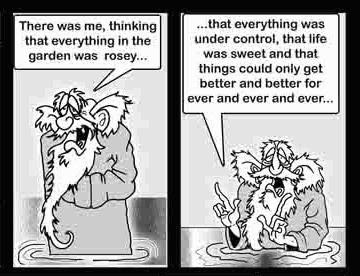
(Cartoon below by Climate Cartoons. Click on the panel to view the whole strip.)

Climate Cartoons Imagine My Surprise

Sunday, November 25, 2007

Ethical Frugality

I believe in living frugally. But I have some ethical principles I won't bend to save money. I wouldn't steal from a shop to get goods for free. That goes without saying. But some cheap goods are only cheap because the producer has been robbed by the retailer. That's why I insist on Fair Trade products such as coffee and chocolate. I refuse to save my family money by robbing the families of coffee growers who have less than we do. And I won't get my milk from the supermarket even though it is much cheaper than getting it from my milkman. The supermarkets rob the dairy farmers by paying them less than the cost of production, and a dairy farmer goes out of business every week because of it. I want my family to save money, but I won't do it by benefiting from the suffering of others.

Cartoon from Climate Cartoons. Click to enlarge.

Saturday, November 24, 2007

Fulfillment Curve

On Buy Nothing Day, I'd like to tell you about the fulfillment curve, or why money doesn't buy happiness.

The curve shows how much fulfillment you get for the money you spend. According to Joe Dominguez, the originator of this idea, when you're just starting out you spend money on things you need. For example, if you lack the basic necessities of life, then every few pennies you spend on food, warmth, shelter, gives you maximum fulfillment. How refreshing is a glass of iced water when you're truly parched?

But once all your basic needs are met, it requires more and more extra money to get just a little bit of extra fulfillment. In The Tightwad Gazette, Amy Dacyczyn gives as an example:
...the fulfillment received from the first $200 car as a teenager versus the $20,000 car bought 10 years later. The new car was nice ... but not 100 times as nice.

What's the message? The adverts lie (well, duh!). You can't buy happiness. Unless you're buying food when you're starving or shelter when you're cold, the things you buy are never quite as satisfying as you hoped they'd be. You know it's true. So save your money for when you really need it, and seek fulfillment in ways that money can't buy.

Wednesday, November 07, 2007

Slow Food

I've been reading about the Slow Food organisation:
Slow Food is a non-profit, eco-gastronomic member-supported organization that was founded in 1989 to counteract fast food and fast life, the disappearance of local food traditions and people’s dwindling interest in the food they eat, where it comes from, how it tastes and how our food choices affect the rest of the world.

I agree with all of that. They seem to have started out as a group of gourmets who were interested in fighting the growth of fast food and supporting fine dining. But their mission has developed and now they also support fair trade, biodiversity, local food, seed banks and heirloom varieties, and organic farming. They oppose monoculture, factory farms and agribusiness, genetic modification, and the use of agrichemicals.

I think it's a great example of how ethical issues and quality of life issues complement each other. I began gardening organically because of environmental and health concerns, but it has had an enormous impact on the flavour and freshness of the food I eat, and has improved my quality of life in various other ways as well. The gourmets and the greenies are on the same side. It's a surprise, but a very nice one.

Monday, August 06, 2007

I Believe...

I believe that green shopping is a red herring.

We can't shop our way out of ecological catastrophe (or spiritual emptiness).

The green revolution is not just for the middle class who can afford to pay extra for trendy fair-trade organic recycled chic. The middle class habit of buying far too much stuff is the problem, it can't be the solution.

The solution is to buy less stuff. Just buy less. It's not expensive. It's not hard. It's not rocket science.

Stuff. You don't need it.

Monday, July 23, 2007

What are Carbon Offsets?

This month I've been writing about carbon - what a carbon footprint is, how to calculate it, what it has to do with climate change, and so on.

Our modern lifestyles have released a lot of extra carbon into the atmosphere. Can we somehow trap it again? Trees trap carbon, so does the soil. Can I fly to Malaga as long as I pay someone to plant a bunch of trees for me? Does that work?

There's an interesting video about carbon sequestration which you should look at if you have about 9 minutes to spare. It explains how organic farming can help trap some excess carbon in the soil, which just adds to the long list of reasons why organic farming is a good idea. I love the guy who narrates it, Percy Schmeiser. He's pretty rubbish at looking natural in front of a camera and reading from a script, but this somehow makes his statements more convincing. He must know what he's talking about because he sure as hell wasn't chosen for his presenting abilities.

But that's different from paying someone to plant trees for you so you can fly to Malaga with a clear conscience. Carbon offsetting is a last-ditch option. It's like having chemotherapy when you've got cancer. You don't say "Oh, I might as well smoke as many cigarettes as I like because I can always have chemotherapy if I get cancer". Similarly we shouldn't say "It's perfectly OK to live a high-carbon lifestyle because I can afford to offset it by planting loads of trees someplace". It's a radical attempt to fix damage already done, not a "get out of jail free" card.

Yes, we should be planting trees, returning to organic farming, collecting methane and all the other carbon offsetting things. But we should be doing them to offset the damage we have already done, not as a sort of "indulgence" permitting us to carry on with our planet-damaging activities and still sleep soundly.

Sunday, July 22, 2007

Have a Break...

Stephanie will probably shout at me for buying Nestlé, but my excuse is that now they've returned to the beloved paper-and-foil wrapping, KitKats' packaging is 100% recycleable, which is more than you can say for Geobars.

Cartoon from Throbgoblins. I've just noticed that I've printed these in reverse order so they don't make much sense. Doh! Next Sunday I'll be sure to print the cartoons the right way round.


Thursday, July 19, 2007

Dead Zone in Gulf of Mexico Set to Break Records

Agricultural fertilisers which run off fields and flow into rivers form dead zones when they are washed out to sea. The fertilisers which feed farmers' crops also feed the microscopic plant life of the sea - algae. Huge sheets of algae form which starve the surrounding waters of oxygen. Nothing can live below - no fish, no sharks, no whales, coral, nothing.

The Gulf of Mexico dead zone is expected to be a record-breaker this year, exceeding last summer's 6,662 sq miles (17,255 sq km). That's pretty close to the area of Wales (for some reason, these things almost always are). Imagine that - a region of sea which should be teeming with fish and other life, covered in a blanket of green algae but otherwise dead.

So next time you're wondering whether it's worth paying the extra for the organic fruit and vegetables, ask yourself instead whether the cheaper cost of conventional fruit and vegetables is worth a 6,662sq mile dead zone in the Gulf of Mexico.

Monday, June 25, 2007

Drive Slower, Cut Carbon Emissions

How are you getting on with the Drive Slower Challenge? 33 people have voted so far and there are still 5 days left until the poll closes. If you want to vote, the poll is in the right-hand sidebar.

Why do I want you to drive slower anyway? Well, it's safer, and it saves fuel which saves you money, but mainly because it reduces carbon emissions. Some of you may be well-versed in the whole carbon issue, but I suspect many people are still kind of fuzzy on what it's all about. So here is:

A (VERY) BRIEF HISTORY OF CARBON

Carbon dioxide is a natural part of earth's atmosphere, even though only in tiny amounts (4 parts in every 10,000). But it's the second most important greenhouse gas. That means it has a huge effect on the atmosphere's capacity to retain heat, trapping energy in our atmosphere.

It's not the most important greenhouse gas - that would be water vapour. The amount of water vapour in our atmosphere isn't changing. But the amount of carbon dioxide is, because in recent human history we have burnt off massive amounts of coal and oil and natural gas - fossil fuels. I'm sure you remember from school science lessons that fossil fuels are formed from prehistoric living organisms, such as animals and plants, that got trapped under rock and buried deep under the earth. This sealed away enormous amounts of carbon and stored it up for millions of years. But in just the last hundred years we have dug most of it up and burned it, releasing it into the atmosphere again.

GLOBAL WARMING? BUT I FEEL COLD!

All this extra carbon dioxide increases our atmosphere's capacity to store energy. Overall, this means global temperatures are rising. But locally it can mean warming or cooling, more rain, or drought. It means the disruption of familiar patterns and weather chaos. Some sceptics gets their knickers in a twist about this, but it makes sense. My friend Jim Finnis once explained that the climate is a bit like a child's swing. If you put more energy into it, say by giving it a hard shove to the left, you don't expect it to just move over to the left and stay there. You expect it to swing about more, both more left and more right. More energy means more everything. Just more weather.

SO WHAT CAN I DO ABOUT IT?

Good question. I feel really strongly that we can't dither about and wait for someone else to fix this for us. I hope that governments will do something to fix it, but that will only happen if the voters demand it. I hope that businesses will do something, but that will only happen if stockholders demand it. I hope that scientists will find more solutions to it, and they are doing that. But we already know the solution - every one of us has to take responsibility for emitting less carbon dioxide.

Driving slower is one way to start.

Wednesday, May 09, 2007

Humane Pest Control

Andrew made some interesting comments about humanely dealing with rodent problems.

... if we're trying to be eco-friendly, shouldn't we be trying to do this to all our furry friends, not just the pretty ones?? ... please please please save all the envirmonment, not just the cuddly bits!!

Point taken. But I don't think "eco-friendly" means the same thing as "kind to animals". Some people belong to both camps, but some belong to just one or the other. And sometimes the two ideas clash. For example there was a story in the news recently about whether it is ethical to hand-rear a polar bear cub rejected by its mother, or whether it should be allowed to die, since that would have been his fate in the wild.

I think Andrew his the nail on the head when he said:


I think we also need to remember, with our ever increasing urban sprawl, that it's us that have invaded their environment, not the other way around.

It opens up a can of worms when humans start interfering with nature. If you found an abandoned polar bear cub in the wild, perhaps it would be an easier decision to leave it to die "as nature intended", but since it was born in a zoo so is already in an unnatural situation, where do you draw the line?

If rats tried to set up home in a fox's den, would the fox deal with them humanely, or would it just kill them? Obviously, in nature when two species clash the matter is resolved swiftly and mercilessly. But it's different when it involves humans for two reasons. First, we are just so much more effective than other animals at what we do. No other species has ever had such a massive imapct on the planet and every other organism in it, because of the technology we have created. And secondly because we are intelligent, we ought to be able to predict the outcome of our actions and behave in a way that does not lead to irreversible damage and destruction, if only for selfish reasons: we want out own species to be able to survive.

So where does that leave me and my rat problem? I'd love to hear your thoughts.

Wednesday, May 02, 2007

How Green Is Your Car?

I want to confess to one of my worst eco sins. I drive a big, gas-guzzling car.

At the time we bought it, it seemed to make sense. We weren't as aware of the damage to the environment caused by thirsty cars. And we needed a big car to fit three baby seats when the kids were all small. A saloon car just wouldn't do it.

But now the kids just need booster seats rather than baby seats, so they can fit in a much smaller car. And we have realised we can always hire a big car on the one or two occasions a year we really need it, such as going on holiday. It's time to trade down to a smaller car.

How environmentally friendly is your car? You can type its details into http://www.whatgreencar.com/ and get a rough-and-ready eco-rating. Ours scored 68% overall rating (confusingly, high numbers are worse, so that's quite a poor score), with 89% climate change score (a dire score) and 37% air quality (not a bad score). We're hoping to improve on that considerably with our next purchase, and save ourselves money on fuel, road tax and running costs as well.