It rained the whole time in Ireland, but we had fun despite it. We went to the boat my dad keeps with his friend on Lough Derg. We went to Bunratty castle and folk park, we played a D&D game with the kids, and we invented our own board game and played that. I taught Steph to crochet granny squares and we started work on an afghan for dad. Dad read us poems by Robert Service, Rudyard Kipling and Banjo Patterson whilst we crocheted. I practiced a new bluegrass fingerpick I was learning on the guitar until I drove everyone crazy (but they all agreed I had improved by the end of the week).
The kids played in the Irish farmland surrounding dad's house come rain or shine. They shoveled up gravel from a heap and scattered it all across the yard; on the last day Steph and I spent an hour sweeping it back into a heap. The kids furnished a "den" in the hedgerow by the lane and spent a lot of time carrying stuff up there.
We watched a clutch of swallow chicks in dad's barn get bigger and bigger - before long they'll be ready to fly. We identified most of the wild flowers we found on dad's land (ragwort, greater plantain, ribbed plantain, welted thistle, creeping thistle, creeping buttercup, herb robert, yarrow, short-fruited willowherb, selfheal and others) and we identified all the birds (goldfinches, house sparrows, dunnocks, wrens, robins, chaffinches, blue tits, great tits, greenfinches, jackdaws, hooded crows, wagtails, swallows, and others).
Tomorrow we're off on our travels again - to London this time with Ed (he didn't come to Ireland) for our main family holiday of the year. I'll resume normal regular blogging when I return.
Showing posts with label biodiversity. Show all posts
Showing posts with label biodiversity. Show all posts
Saturday, August 23, 2008


Monday, August 04, 2008
Bats
 Bats are among my favourite regular garden visitors. Other people may listen for the first cuckoo of spring, or look out for the returning swallows, but for me the first bat flying past my bedroom window marks the beginning of the warm season, and their disappearance tells me winter is on the way.
I sleep with my bedroom curtains open. My bedroom backs on to open fields and is not overlooked at all so I don't worry about privacy. I love to look at the stars or simply the clouds, although the moon is never visible from my bedroom window which is a bit sad. I like to be woken by the sunrise and in particular I like to watch the bats. I wish I could show you a photograph but they're incredibly fast and almost impossible to photograph on the wing, and I don't know where they roost so I can't show you a photograph of them resting. The (rather fuzzy) photo I have included is of some bats we saw roosting in a souterrain in Craggaunowen in Ireland last year.
I don't know what species they are. There are 17 species of bat in Britain, which is about a quarter of all our mammal species. The most common is the common pipistrelle, which is also the smallest at less than 2 inches long. The rarest is the greater mouse-eared bat which was thought to be extinct in this country but was recently discovered living in the south of England. The largest British bat is the noctule, but even this is only about 3 inches long and weighs less than 1 1/2 oz (40g). British bats are diddy, although their wingspans make them look bigger than that.
Sadly, like much of our native wildlife, British bats are in trouble. A combination of loss of habitat and insecticides wiping out their prey has caused their numbers to decline sharply. Now all British bats are protected by law. It is illegal to harm them or disturb them, or muck about with their roosting sites.
I've recently discovered you can get bat detectors - electronic devices which can hear the bats' sonar sounds and can identify the bat from the frequency of its squeak. They're not cheap, but maybe my local bat conservation group or wildlife trust can lend me one to identify my bats. I'll be looking into that and I'll tell you how I get on.
If you want to find out more about British bats, visit the Bat Conservation Trust.
Saturday, July 26, 2008
Meadow Brown
 We took the kids up to Lyme Park and whilst they were running around bellowing I took some photos. They all came out rather under-exposed, so I'm going to have to figure out how to fix that. But apart from that I was quite pleased with this one of a meadow brown butterfly drinking nectar from a thistle.
Friday, July 25, 2008
Great Crested Newts
 I had a lovely picnic yesterday with my kids, my sister Stephanie and her kids, and our sister Lindsey. We all met up in Calderstones Park, Liverpool.
We had our picnic close to a small pool. My 6-year-old son, Sam, pointed out a plaque which said there were great crested newts in the pond. Great crested newts are a protected species in the UK and it's great to know that they are thriving there in the middle of Liverpool, although we didn't see any newts ourselves.
I got chatting to a woman who was tending a small memorial to her daughter who had died of cancer six years ago. There were some flowers planted around the base of a tree near the newt pond with a discreet plaque identifying the place where the young woman's ashes were scattered. The woman told me that sometimes she and her surviving daughters came and had a picnic together in this place so they could all be together again. I thought that sounded really nice.
But the woman expressed regret that the pond was in such such a bad state.
"They've let it go all stagnant," she said "It used to be clean and there were ducks here"
I got the feeling it spoiled their family get-togethers, this idea that the pond was neglected. So I pointed out the plaque and explained about the newts. I said that the pond wasn't stagnant - it wasn't covered in weed or algae and it didn't smell. It seemed to be well-tended because it didn't have any litter in it or around it. The water looked a little muddy, but presumably the newts liked it that way since they were reproducing here. There was another, larger lake in the park where the ducks lived, and it's a good thing there were no ducks in the newt pond because I guess the ducks might eat the newts and their larvae. I also pointed out a five-foot wooden sculpture of a newt amongst the trees by the pond.
By the end of our conversation the woman seemed much happier about the pond. It's a shame to think that there had been the least shadow over her daughter's memorial because she believed the pond was dirty and neglected. I'm glad I could help to lift that shadow, and I hope that the next time she and her other daughters get together there, they will discuss the rare newts in the pond. It's a beautiful little spot to spend eternity. I wouldn't mind being scattered somewhere like that myself when the time comes.
Great crested newt painting by Stephanie Smith
Wednesday, April 30, 2008
Make A Little Birdhouse In Your Soul
I've been watching a bluetit carrying nesting materials to the birdhouse in our back garden. Hopefully he'll attract a mate and raise a clutch of chicks like last year. Here are some images I found when searching for "recycled bird house". Each image is a link to the page it comes from. Some of them have instructions how to make the item, some are ready-made items for sale, and some are out-of-date and no longer for sale, but I thought they could be inspiration for your own recycled bird house projects.


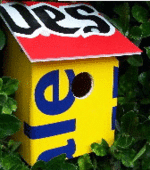
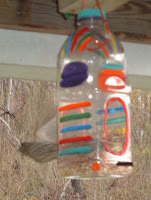

If you make a recycled bird house, please email me a photo, and say whether you're happy for your image to be used on the blog.
If you make a recycled bird house, please email me a photo, and say whether you're happy for your image to be used on the blog.
Wednesday, April 23, 2008
Hoverfly
 It was a beautiful spring day here yesterday - bright and still, although cold. So I put on a warm coat and scarf and took lots of photos. I was pleased with this one of a hoverfly.
Hoverflies deliberately mimic bees and wasps which fools some people who can't tell them apart. My kids get in a panic when one comes near them. I always tell them "If it's hovering, it's a hoverfly". Bees and wasps don't hover like that. This one was stationary on a marsh marigold flower, but it was still easy to tell what it was. The biggest clue is the eyes. Flies have fly eyes. Bee and wasp eyes are different. Here's a nice closeup of a hoverfly's head. And here's a worker bee head for comparison. The feelers are another giveaway - bees have long busy feelers, flies have short stubby ones. Another giveaway is the wings. Flies have two wings; the Latin name for the order is diptera which means "two wings". Bees always have four. And it's clearly not a wasp as it has a fat waist, not a wasp waist. I don't have a wasp waist either, so I won't hold that against it.

I like to see bees in my garden because they do a lot of good pollinating plants, resulting in more flowers and fruit. Hoverflies are also welcome visitors because they pollinate as well, and their larvae are hungry predators who gobble up aphids and thrips. It's all biodiversity, so it's all good.
Thursday, March 06, 2008
February Bird List
 Birds I have seen from my house in February 2008:
- Blue tits (some are inspecting the nesting box on the wall of the house)
- Great tits
- Crows
- Woodpigeons
- Robins
- Sparrows
- Dunnocks
- Wrens
- Blackbirds
- Magpies
- Jays
- Starlings
- Canada geese (NEW - didn't see these in January)
- Pheasant (NEW - didn't see these in January either)
That's 14 species. Birds I saw in January that I didn't see again in February include long-tailed tits, woodpecker, gulls, herons, nuthatch, chaffinch. But didn't spend as much time birdwatching this month. So they were probably there, I just wasn't looking out of the window at the right time.
It was only a few years ago I decided I wanted to be able to identify all the birds that frequent my garden. I'm not a dedicated "twitcher". I have no interest in going to some desolate spot and sitting in a little camouflage tent in the driving rain in the hope of spotting some rare bird.
But I was delighted at how quickly I learned to identify my local garden birds. It was quite strange; I would have told you that I didn't get many birds in my garden, and most of them were all the same - a mass of small similar brown birds. But when I started watching I realised there were quite a few birds I could already identify - robins, blackbirds, magpies etc. And the "little brown jobs" eventually separated themselves out into sparrows (male and female quite distinct), chaffinches (again males and females are different), dunnocks, wrens and a few other things. Blue tits and great tits stymied me at first but now they look totally different, I don't understand why I found it so hard to tell them apart. Woodpigeons and collared doves also confused me for a while. And I don't know why it took me so long to decide whether the big black things I could see were crows, rooks or jackdaws - they're quite different from each other when you know what to look for. But I still can't tell gulls apart at all. And there's a little grey-and-white fellow I see sometimes who is either a marsh tit or a willow tit, but in every book I've read they look completely identical to me so I've no idea how to decide which one he is.
If you can't already identify your neighbourhood birds, I recommend you get a good bird book and start keeping a monthly list. It's not hard. It seems hard at first but once you've identified a regular visitor you never have to do it again. It's free. It's not time-consuming. I do it whilst I'm doing other things, the washing up, for example. And it's a lovely skill to have.
Monday, February 04, 2008
There's a Rat on Mi Bird Table, What Am I Gonna Do?
 Dad (Bill in Ballaugh) has been enjoying feeding the birds and watching them from his kitchen window. But he phoned me up for advice when he saw a rat helping itself to the bird food.
The chances are he's always had rats in his garden. He just hasn't spotted one before. He lives on a hillside in rural Ireland, surrounded by small dairy farms. The landscape will be full of rats, and it's OK. It's probably also full of field mice, foxes, squirrels, bats, rabbits, hares and all sorts of lovely things. If he saw any of those in his garden he'd be delighted, but he's not so keen on the rat. I don't blame him - if I saw a rat I'd wonder if it might come in the house, where it definitely would not be welcome. I wouldn't welcome squirrels or bats etc. in the house either. But still, I don't think spotting a rat in your garden is cause to panic.
There's no need to stop feeding the birds. But there are steps he can take to try to make sure the birds get the food and the rat does not:
- Feed on the bird table, not on the floor.
- Rat-proof the bird table - an inverted cone of metal or chickenwire, or one of those big round tins you get chocolates in at Christmas, inverted and attached round the post, might stop rats climbing up.
- Only feed enough for one day. Feed in the morning, and clear up any leftover food at night. Birds don't come to the birdtable at night so this doesn't deprive them of anything. But it deprives the rat of a midnight snack. I know dad saw his rat in the daytime, but it could have been visiting the table at night for weeks before he saw it.
- I wonder if those squirrel-proof bird feeders also keep rats out? I've seen a spinning bird-feeder - the weight of a squirrel or a rat causes it to spin faster and faster, flinging the unwanted mammal right off. The video is hysterical. I think if I had one I'd be praying for squirrels and rats to vsit it, just for the laugh.
Wednesday, January 30, 2008
January Bird List
 Birds I have seen from my house in January 2008:
- Great tits
- Starlings
- Blue tits
- House sparrows
- Robins
- Crows
- Magpies
- Blackbirds
- Jays
- Dunnocks
- Wrens
- Woodpigeons
- Treeful of long-tailed tits (about 8 or so tits in an oak tree)
- Great spotted woodpecker (only saw him once)
- Gulls (dunno what sort, I don't do gulls)
- Herons
- Nuthatch (just saw him once, but he hung around for ages so I got a good look at him)
- Chaffinch (male, I only saw one)
Saturday, January 26, 2008
Big Garden Birdwatch
 This weekend is the RSPB's annual Big Garden Birdwatch. You're asked to spend an hour watching birds in your garden and then submit your results to the RSPB, using their online recording sheet. Last year 400,000 people took part, which makes it the world's biggest bird survey. It's serious scientific research, providing valuable information about British birds:
The survey has recorded the huge declines in some of our most familiar birds. Since 1979, the number of house sparrows counted has fallen by 52% and the number of starlings by 76%.
However, it isn't all bad news - chaffinchs and great tits have both seen their numbers increase since 1979 by 36 and 52 per cent respectively.
Our scientists can then use these patterns in bird numbers to help prioritise our bird conservation work.
Why not spend an hour this weekend watching the birds, and help contribute to this vital research?
Cartoon from the talented and curiously attractive chaps at Climate Cartoons. Click on the panel to read the full strip.

Thursday, January 03, 2008
Recycled Bird Feeder
 A friend of mine from a Usenet group, Ivan Reid, invented a quick and easy recycled bird feeder using a Pringles tin and a sardine can. There are instructions of how to make it on his webpage.
He says the design has been slightly refined over the years:
You might want to note that it finally succumbed to the elements after about 2-1/2 years. Also it's very windy in my backyard and I kept losing the cap off the top, so I cut the top off a 1-1/2 litre mineral-water bottle just below the neck and slipped that over the top to keep the rain out.
I like it a lot. Of course, it's not exactly a thing of beauty. But I don't put out birdfeeders to adorn the garden. I put them out to attract the birds, which are more beautiful than any garden ornament.
Tuesday, October 09, 2007
The Swallows Are Gone
 The swallows are gone. So are the housemartins. I didn't notice exactly when it happened, but I was standing at the end of the garden yesterday, looking over the field behind the house, when it occurred to me I hadn't seen any for a while.
They'll be back next summer. In the meantime I shall look out for the winter visitors, the ducks, geese, swans and redwings, and huge noisy flocks of starlings. But it is a significant moment. The swallows are gone. Summer is gone, as much as we had a summer this year. Winter is on its way. I wonder what it will bring.
Tuesday, October 02, 2007
Weed of the Week - Nettle
 Does anyone really need a photo or a description to help them identify stinging nettles? I tell you what; if you're unsure whether a plant is a stinging nettle or not, brush up against it. If it hurts, it is one. Stop whimpering. Find yourself a dock leaf and crush the juice into the sting, it'll soon relieve the pain.
Nettles don't form such deep root systems as docks and so are easier to remove in that sense. However you have to wear gloves and a long-sleeved shirt made of fairly thick material, otherwise you'll end up with very sore hands and arms. But once you've pulled them up, you can throw them on the compost heap, make weed tea, or put them to many other uses.
I love to make them into delicious soup. I've also made them into soap. The least application of heat and their stings are totally disarmed - I saw Ray Mears on TV wilt them by holding them directly over a fire, and then he ate them. They're best in the spring; once summer gets well advanced they seem to become gritty, however well you wash them.
You can also make nettle beer, apparently, by boiling 2lb of nettles with the rind of 2 lemons and 1 gallon of water for 15 minutes. Strain into a container and add the juice of the 2 lemons, 1lb of sugar and 1oz cream of tartar. When cool, add 1oz yeast and leave in a covered container in a warm place for 3 days. Then strain into bottles, cork down and wire, and leave for 1 week before drinking. I've never tried this recipe, which comes from Marguerite Patten's out-of-print book 500 recipes for Home-Made Wines and Drinks, but next spring I'll give it a go.
There's even a website dedicated to nettle appreciation, where you can read about the importance of nettles to native British wildlife, and the uses of nettles as food, medicine, clothing (eep!) and in the garden. I wouldn't go that far, but I feel more kindly towards nettles than I do towards docks, for example. Not so kindly that I won't rip them out of my allotment when I find them. But kindly enough to appreciate the patch in the farmer's field behind our house. They're a useful resource, as long as they're growing on somebody else's land, not mine.
Wednesday, August 22, 2007
I'm Back
 The BBC has been asking where do climate change protesters go on holiday? Well this one went to Ireland by ferry. We stayed at my dad's house near Abbeyfeale (thanks, dad). He has an old stone-built cottage set in 2 1/2 acres with stunning views of the Mullaghareik mountains, where he gets to watch swallows and hooded crows, wild hares and pheasants, and gets nettled when I point out there's good eating on some of those. He isn't connected to mains water, but when he turns on his taps he gets spring water that rises on his own land. He isn't served by mains gas, either, nor does his rubbish get collected so he has to be careful about what waste he produces.
Unfortunately it rained every day we were there. We braved the weather to visit Bunratty Castle and Folk Park. It's a fabulous place to visit - they have restored the 15th century castle there, and recreated lots of 19th century dwellings such as a fisherman's cottage, or a wealthy farmer's house. There is also a 19th century street recreated with a sweet shop, drapers' shop, pub etc. I especially enjoyed the walled gardens and the watermills.
We had better luck with the weather at Craggaunowen, which goes back further to prehistoric times. It has recreations of neolithic  dwellings, including a ring fort with a souterrain (underground storage for food and valuables), which provided the highlight of the whole trip. Ed spotted a small cluster of bats roosting in there, and we got to watch them from extremely close up. I don't know what's going to happen to them now, as I believe they are protected in Eire as they are here in the UK. Either they'll have to be moved, I guess, or the souterrain closed to the public. Either way we were extremely fortunate to see them.
 dwellings, including a ring fort with a souterrain (underground storage for food and valuables), which provided the highlight of the whole trip. Ed spotted a small cluster of bats roosting in there, and we got to watch them from extremely close up. I don't know what's going to happen to them now, as I believe they are protected in Eire as they are here in the UK. Either they'll have to be moved, I guess, or the souterrain closed to the public. Either way we were extremely fortunate to see them.
We also visited King John's Castle in Limerick and saw a trebuchet being fired, went swimming in Tralee Aquadome, the kids played in a den with a rope swing my sister Steph had made the week before among dad's hedgerow, I played traditional music with my sister, Lindsey, who was there at the same time, and we enjoyed cooked Irish breakfasts every day, and delicious home-cooked food every evening. Even the mini-bar was free. It beat staying in a B&B hands down.
Wednesday, August 08, 2007
Extinct
 Here's a quick quiz - how many large vertebrates have gone extinct in the last 50 years?
The answer is none. Plenty of large vertebrates are endangered and even critically endangered, such as Siberian tigers and Sumatran orangutans. And species are going extinct all the time, but they're mostly plants, invertebrate animals or small animals - toads, snakes, moths, birds.
But now the baiji, the Yangtze river dolphin, is probably extinct. There used to be thousands of this unique species in the Yangtze river in China, but pollution and river management led to a decline in its numbers. The last one was sighted in 2004, and a recent survey failed to find any at all.
All life is connected, so the extinction of the Essex emerald moth is just as important as the gentle baiji. But it should give us a wake-up call to think that we humans have driven this animal out of existence.
Tuesday, July 24, 2007
Frog Central
 It was dry enough the other day to mow the lawn, but the job was made more complicated by having to avoid the frogs that were all over the place. I really didn't want to slice and dice them so I had to keep my eyes peeled and be ready to do an emergency stop at any time.
I've always known there were frogs, toads and newts in the garden. One year a toad hibernated in our compost heap, and I loved going to have a peek at him. But I've never seen so many of them.
Sunday, June 24, 2007
How To: Make a Lacewing Shelter
 Do you remember when garden centres just used to sell gardening stuff? Now they sell everything from hand cream to cream teas. They seem to do a roaring trade in wildlife shelters, like mason bee boxes, ladybird houses, and bug blocks. I'm really glad that more people are taking an interest in our native wildlife, and trying to help them along. But at the risk of upsetting Wiggly Wigglers again (just teasing) you can make most of these things yourself out of recycled materials.
 Here's how to make a lacewing shelter (why would you want to make a lacewing shelter? because lacewings are beautiful, and also because their larvae gobble up aphids like there's no tomorrow).
You will need some corrugated cardboard, an empty fizzy drinks bottle, scissors or a craft knife and some twine.
First of all rinse the fizzy drinks bottle and cut the bottom off. Leave the lid on, otherwise rain will soak the cardboard.
Then cut a strip of corrugated cardboard slightly shorter than the length of your bottle. It's important to cut it across the
 corrugations, not along them. This is the hardest direction to cut in. So if you're finding it very easy to cut, you're probably cutting it the wrong way.
Score a few lines close together at one end of your strip to make it easier to roll up. Then roll the strip really
 tightly.
Jam it into the fizzy drinks bottle. It needs to be a really tight fit. If it isn't, add more strips of card until you have a nice tight fit.
Tie some twine around the neck and hang it up. Lacewings will shelter inside. You can change the cardboard once a year if it gets ratty.
See? Easy. But if you don't want to make one you can buy ready-made bug habitats from Wiggly Wigglers, who are very nice people.


Saturday, May 26, 2007
Blue Tit Chicks
 There's a nesting box in our back garden and every year it attracts blue tits. They've got a brood of chicks at the moment and it's fun to watch the parents flying backwards and forwards with caterpillars for the noisy chicks. I managed to get a picture of a little gaping mouth at the opening of the box.
Monday, May 07, 2007
Rats!
 One of the advantages of living in the countryside is watching all the wildlife right on your doorstep. One of the disadvantages is when the wildlife crosses your doorstep and comes right inside your house.
We've heard scrabbling and gnawing sounds from the space in between the downstairs ceiling and the upstairs floor for the last couple of nights. Ed went out and got a few traps (the old-fashioned Tom and Jerry type), but we're not sure where to put them to best effect.
I'll keep you posted about our progress in getting rid of these pests. In the meantime if anyone has any experience or tips we'd be glad to hear them.
Saturday, March 17, 2007
Bird Feeder
 Happy St Patrick's Day! My dad sent me a little badge with a living piece of shamrock which I'll be wearing all day. Afterwards I'll pot it up and encourage it to grow in a pot on my kitchen windowsill. It'll make me think of my dad in Co. Limerick whenever I look at it.
My sister, Steph, showed me how to make these bird feeders. You make holes in monkey nuts then thread string through. The blue tits in particular like to hang on them and peck holes in the shells to extract the nuts. I thought the grey squirrels would probably just steal the whole thing and run off with it, but oddly I haven't seen them bother with it at all. If you use natural string (rather than nylon or something) then when it is empty you can just fling the whole thing on the compost heap.
Feeding birds encourages biodiversity in the garden. If you tempt them in for a lunch of peanuts, they might decide to finish off with a dessert of caterpillars and slugs. Site your birdfeeder carefully because bird droppings will accumulate underneath it. These add fertility over time but may be too strong for some plants (and are unwelcome on e.g. lettuce). It occurs to me that if you had a layer of some sort of mulch under the birdfeeder you could change it once in a while and put the mulch plus droppings on your compost heap. Or you could fix the feeder directly above the heap and collect the frtility directly. But to tell the truth I don't feed the birds because it's good permaculture practice. I just feed the birds because I love watching them.
Subscribe to:
Posts (Atom)